A worrying move
First, some history for context. For some ten years until 2017, there was little in the way of legal powers to protect pubs from redevelopment. Permitted development (PD) rights on properties in planning class A4 (pubs, wine bars and other drinking establishments), allowed their use to be changed or the building demolished without planning permission that would have required consultation. A planning authority could however be asked to issue ‘Article 4 directions’ under which change of use or demolition would require full planning permission. Some planning authorities, notably Wandsworth Council, therefore imposed blanket Article 4 directions covering the pubs in their area, prompting the removal of PD rights for A4 premises. This was something for which CAMRA had vehemently lobbied. In 2020 the planning classes were then reformed and pubs became ‘sui generis’ (in a category of their own) with no PD rights.
Sadly, this regime is now under threat. The government are reviewing the National Planning Policy Framework, in particular policy HC6: Retention of key community facilities and public service infrastructure. The intention is ‘designed to avoid unreasonable restrictions being placed on proposals to change the use of existing premises’. The proposal is that the planning protection for pubs, instead of covering all pubs, will seemingly only apply to the last pub in the area, whatever that area might be deemed to be. CAMRA is deeply concerned about this and has submitted a forceful response to meet the 10 March consultation deadline as well as having the issue raised through written parliamentary questions. The outcome is awaited.
As part of an announced support package for pubs, the government is going to consult in the spring on its proposal to introduce a new permitted development right that will allow pubs to turn rooms into accommodation or to extend the main parts of their premises in order to make businesses more viable.
Pubs and noise
There has been another manifestation of this perennial problem. The pub in question this time is the World’s End in Finsbury Park, although the circumstances are not dissimilar to the cases of the Compton Arms in Canonbury and the Globe in the Marylebone Road. The pub was the subject of complaints about noise from a neighbour who had moved in about a year earlier and who successfully applied to Islington Council for a review of the pub’s licence. This was a very worrying development for the World’s End’s management because it regularly hosts live music, and relies on it. Owners Greene King explained to the committee that various measures had been taken to reduce the noise level but they were not considered adequate. There was no suggestion that noise levels had increased over the period of the complaints. The pub neighbour was supported by the Council’s noise team while the pub was well supported by customers. A compromise was reached that the pub would end live music at 11pm while its management worked with Islington’s noise team on a long-term solution.
I normally keep to simply reporting the facts but here I would like to make some suggestions because we clearly have a situation that needs regulation. While I fully appreciate a neighbour’s legal right to the ‘quiet enjoyment’ of their property (and here ‘quiet’ means peaceably and without interference, not necessarily free from noise), the neighbour cannot have been unaware that the next-door building was a pub. Due diligence should have been exercised to establish what the implications of this would be. After all, the pub, as a business, also has rights. No-one should be allowed to challenge a pub’s licence in such circumstances. That said, if it can be proved that noise levels have substantially increased at any time to the point where they become a nuisance, a complaint would be justified. I would however expect any complaint only to be accepted if it came from, say, at least five neighbours, not just one. Furthermore, Councils should not be allowed to vary existing licence conditions or impose new conditions following a review where no fault has been found, especially if this involves the pub in substantial additional costs.
I should add that the general adoption of the ‘agent of change’ principle, as included in the current London Plan, has largely solved this problem for new and converted buildings. For example, if an office block next to a pub or music venue is being converted to residential use, it is the building being converted that must be soundproofed, not the pub, and the developer meets the cost.
Whitewebbs Toby Carvery
This is curious. Last April, an oak tree, said to be between 300 and 500 years old, and which stood next to the car park adjoining the Toby Carvery in Whitewebbs Park in Enfield, was cut down by contractors hired by the carvery’s owners, Mitchells & Butlers. They said that it was dead and a danger to customers. The building and site are owned by Enfield Council and leased to M&B. M&B did not ask Enfield’s permission to fell the tree and, according to the Council’s deputy leader, the act shocked and angered the entire community. The tree was locally known as the ‘Guy Fawkes Oak’ as it is close to where the Gunpowder Plot was planned. The Council has now placed a Tree Protection Order on the stump – perhaps some of the wood could be used to make a stable door – and reported the incident to the police as criminal damage, although the police decided no action was warranted.
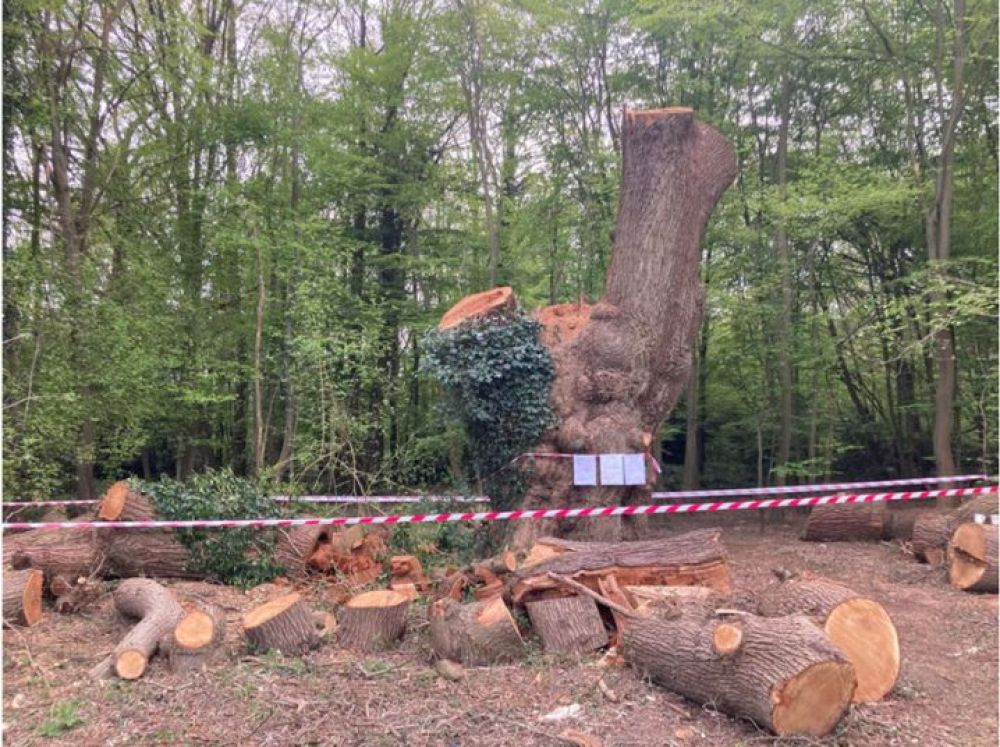
The story would probably have ended there until recently when the ‘dead’ stump started to grow shoots. These shoots need special treatment to grow and M&B, who have yet to apologise, were asked to pay for this, estimated at around £10,000. They refused. In retaliation, the Council have now served M&B with a legal notice for the forfeiture of their lease. There will be more to report on this, I suspect.