Evin O’Riordan is a softly spoken enigma. He was born in New York State and grew up in Ireland. He studied Russian and history at degree level before moving to London to take a Masters’ degree in literature and philosophy at Goldsmiths College. He then went to work for Neal’s Dairy, which is where the story of Kernel really began. He was tasked to go to America to set up a shop there and was so taken by the beer scene that he decided that he wanted to set up his own brewery. So, in 2009, he took the plunge and leased a railway arch in Bermondsey.
Evin started with a four-barrel brew length kit and concentrated on bottles, using a small bottle filler and labelling by hand. He was aided by two friends, Rob and Chun, who still works for the brewery. When asked why it was just bottles, Evin said, “I didn’t know any better. I was a home brewer, so had a good idea about bottling. Having worked for Neal’s Dairy, I understood the retail market of shops rather than pubs and the margins were slightly better. It also helped get the brewery known, as people shared bottles and that helped word of mouth.”
After three years, Evin decided to expand, moving to a new railway arch and installing a 20-barrel kit. But the move came with a condition: the leaseholders only allowed Kernel to have a tap room alongside the brewery if they agreed to move the tap room to new premises nearby once that building was ready. “That took 13 years,” Evin said with a wry smile. “It wasn’t until January 2024 that we moved in and it took us some time to make it habitable; we opened in August that year.”
The new tap room is modern and clean; not your usual tap room but welcoming all the same. Evin explained, “The tap room provides a useful showcase for our beers. Although the brewery and the old tap room are only around the corner, most people didn’t know we were there. As part of our licence, we had to have a kitchen and Yagi Zakaya runs that side of the business. That has helped us attract a mixed audience.” The opening wasn’t without obstacles, however, because local residents were concerned that the tap room would be an extension of the ‘Bermondsey Mile’. “We had to reassure them that wouldn’t be the case. Shutting at 10pm each night also helped,” Evin said.
The tap room accounts for 8% of Kernel’s sales; the rest is through pubs. Keg has played a bigger part, particularly since they moved into the new tap room, but there are always two cask beers available. Bottles account for 35% of their total sales. When asked about bottles versus cans, Evin explained that there were a number of reasons why they continue to use bottles. “We bought the bottling line about nine years ago and at that time there were fewer options and there wasn’t a canning line of the same quality as a bottling line for a brewery of our size. We have looked at it from a carbon footfall point of view and there isn’t much difference. We have no way of knowing if the aluminium comes from the Far East or Poland. Also, the problem with cans is that it is hard to pour to allow for the sediment; all of our beers are bottled conditioned.”
Kernel’s beers are forever changing. The demand might be for a pale ale but the brewer will decide on what hops to use; they see no need for each beer to taste the same as the last batch, as with many breweries. This allows the brewer the freedom to experiment and constantly improve the recipes.
There are 18 staff, of whom eight work in the brewery. Evin explained, “Everyone who works in packaging will also brew from time to time. This allows us to cover for sickness and holidays and it keeps them interested. I still brew occasionally, about every two weeks. I have just brewed our annual collaboration with Redemption, Victorian Mild. We also do the odd collab with Burning Sky.”
Evin said he has no plans to grow further. “With this number of staff, I know everyone personally and they are given the authority to make decisions and to take pride in the quality. We aim for a good environment to work in, showing respect to everyone. This helps create a culture where everyone cares; holding true to what we believe in.”
When asked what makes Kernel different from other breweries, Evin replied, “We are still here after sixteen years. The market hasn’t really still recovered post Covid and both pubs and drinkers are finding it difficult but we didn’t set up Kernel to sell up, like some other breweries.”
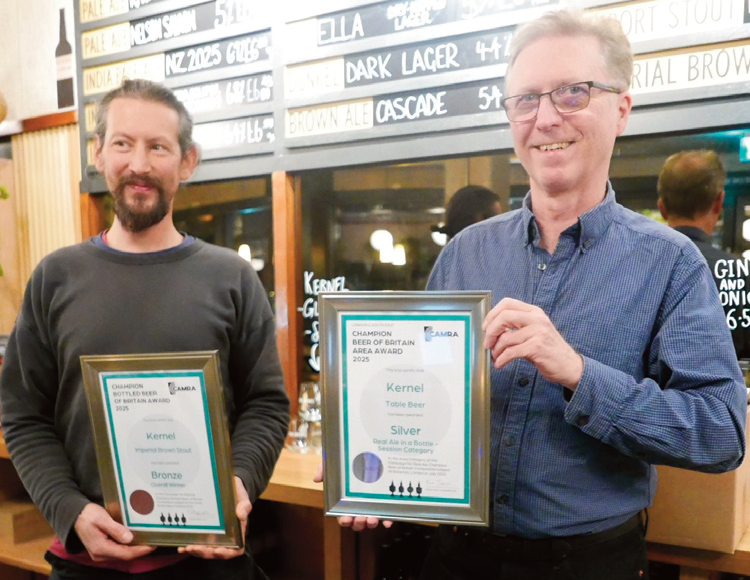
So, it is likely that Kernel will be around for a while yet. With the brewery recently winning a Silver award in the CAMRA London & South East Champion Bottled Beer of Britain competition for their Table Beer and Bronze in the National Champion Bottled Beer of Britain with their Imperial Brown Stout, it’s clear that Evin’s commitment to quality beer continues to pay dividends.
The London Tasting Panel notes from the visit can be found on CAMRA’s Regional website: www.london.camra.org.uk. If you are interested in joining the panel, details of the next training course can be found at https://tckty.camra.org.uk/e/435/taste-training.
Christine Cryne