On Saturday 14 October, CAMRA’s London Pubs Group (LPG) had a daytime tour of Brentford, Acton Green and Turnham Green. We started at 12 noon in the Express Tavern in Brentford. The pub rates three stars on CAMRA’s national inventory of historic pub interiors, which means that it has an interior of exceptional historic importance. The Express was rebuilt in mid-Victorian times and old photographs show three entrances. The sole entrance now is the central doorway, which leads into a lobby with a mixture of Victorian and (perhaps) 1930s glazing. The right hand room retains its original bar fittings but was once much smaller. There were some rearrangements in 1994 when a partition was removed; this had previously created a tiny private bar. The doorway to the former landlord’s parlour has a fascinating double-sided clock over it, surrounded by brown painted and gilt glazing which bears the name of the pub. This suggests a date of about 1870 and, if so, is perhaps some of the earliest surviving pub fittings in London. The left hand room has a fine marble fire surround fireplace, original fixed seating and its original counter. The third room behind was remodelled in Tudor style in 1932, judging by the date scratched on a ceiling beam. The pub is famous for its Draught Bass and there is an illuminated sign on the exterior for it. It is still the biggest selling real ale in the pub. The pub features in the 2024 Good Beer Guide and offers a 10% discount to CAMRA members. Regular real ales in addition to Bass are Big Smoke Solaris and Harvey’s Sussex Bitter. There are seven changing beers and five real ciders.

A bus ride (either route 237 or 267) led to pub number two, the eponymous Bollo. This is a Victorian street corner local, now Greene King (formerly Watney’s) with an attractive green-tiled façade. It was built in 1885 as the Railway Tavern, named after the nearby District Line which had opened in 1879 as the Metropolitan District Railway. It spent the 1990s as the Orange Kipper, before gaining its current moniker in 2000. The name Bollo is derived from the lost Bollo (or Boller) Brook watercourse.

The pub’s interior has been completely opened out but a three bay section of the bar-back with a pleasing coved cornice remains, as does the bar counter front and some extensive wooden panelling, albeit now stripped and scrubbed. The rear area has an impressive fireplace and a circular skylight. The walls are decorated with black and white photographs of the former London Transport Chiswick bus works, which closed in 1990 and is now the Chiswick Park business complex. The pub also offers a 10% discount for CAMRA members. Beers available on the day were Greene King Abbot Ale and IPA.
Next was the Swan, a corner local reached through the backstreets of Acton Green. This is a one star pub on CAMRA’s National Inventory. The description includes: “Ex-Charrington’s two-storey pub of late Victorian London brick with a single-storey, part-rendered, flat-roofed extension at the front and a smaller one to the rear”. The rear extension is faced with brown and green glazed tiling and has leaded windows and stippled glass proclaiming ‘Toby Ale’, ‘Wines’ and ‘Toby Stout’.

The exterior still carries its 1980s ‘retro’ Charrington globe lamps. Some internal fittings are possibly inter-war but the pot shelf and bar-back look to be more modern. Overall, there is plenty of fielded wood panelling to three-quarters height and a 1930s style brick fireplace. At the rear is an extensive and concealed attractive garden. Fuller’s London Pride and Timothy Taylor Landlord were being served during our visit, though St Austell Tribute is often available too.
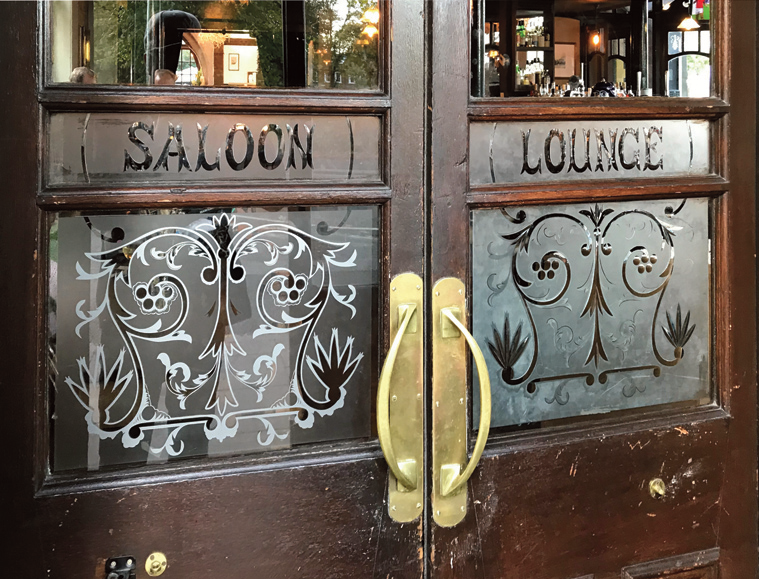
A short walk took us to the Duke of Sussex in Acton Green. This pub is Grade II listed and has two stars on CAMRA’s National Inventory. It was built in 1898 by specialist pub architects Shoebridge and Rising for the Cannon Brewery. The exterior lobby on the right hand side has a mosaic floor and ornamental ironwork containing the pub name across the doorway. There is a horseshoe shaped bar counter that may date from the inter-war period (or original with modern panels attached?) with a modern top. Parts of the partitions that originally sub-divided the room into four survive. The publican’s office with its decorative etched and frosted glass panels remains but is now a wine store. To the rear is a single-storey billiard hall entered through a wide doorway with a carved wood architrave. This is lit by large rectangular lantern subdivided by cast-iron arched brackets. It has a wooden panelled border, carved with cherubs and swags. This room has another good carved fire surround with modern tiles. Though much modernised over the years, it retains an unusually rich, turn-of-the-century pub interior. It takes its name from the original holder of the title, Prince Augustus Frederick (1773 to 1843), the sixth son of King George III, who was granted the dukedom in 1801. The current incumbent is referenced by one of the real ales on sale. On our visit these were Dorking Brewery Pilcrow Pale, Portobello Star and Harry’s Bitter (a house beer brewed by Greene King).
The 10% CAMRA members’ discount is also available here. In the 1980s, the pub was owned by Allied and liveried as Taylor Walker, which was appropriate as the latter had been acquired by the Cannon Brewery in 1930.
Another bus ride, to Turnham Green Station, took us to the Tabard. The Tabard is Grade II*-listed and has two stars on CAMRA’s National Inventory. The pub dates from 1880 and was a pioneering ‘improved’ pub built by architect Richard Norman Shaw as part of the Bedford Park estate, the first London garden suburb. Inside, there are colourful Arts & Crafts tiles featuring snakes and blue birds by William De Morgan. In the left hand bar there are a pair of two tile panels depicting nursery rhyme scenes, hand-painted in blue enamel on Dutch tin-glazed tiles. The pub retains two separate bars, although it also possible to move between them by two corridors. The bar-back is from a 1971 refurbishment but the counter looks original, although with a replacement top.

The pub has been extended to the left into a neighbouring house to create more space. On the first floor is the 79 seat Tabard Theatre, which has been host to the likes of Al Murray and Harry Hill. The concept of the ‘improved’ pub represented a rejection of the gin palace in favour of a more traditionally inspired and respectable inn. Together with the nearby St Michael’s Church, the Tabard was designed to be the social centrepiece of Bedford Park and proved highly influential for subsequent suburban developments. The Tabard was also part of the Allied Brewery empire in the 1980s, although it carried their green Ind Coope branding. Real ale availability was Black Sheep Best Bitter, Caledonian Duechars IPA, and Greene King Abbot Ale, IPA and Yardbird Pale Ale. The 10% CAMRA discount is also offered here.
A tabard was a medieval garment worn by knights and heralds and the Tabard was also the name of the inn from which Chaucer’s pilgrims set off in the Canterbury Tales.
Jane Jephcote and Kim Renn