REOPENING OUR PUBS
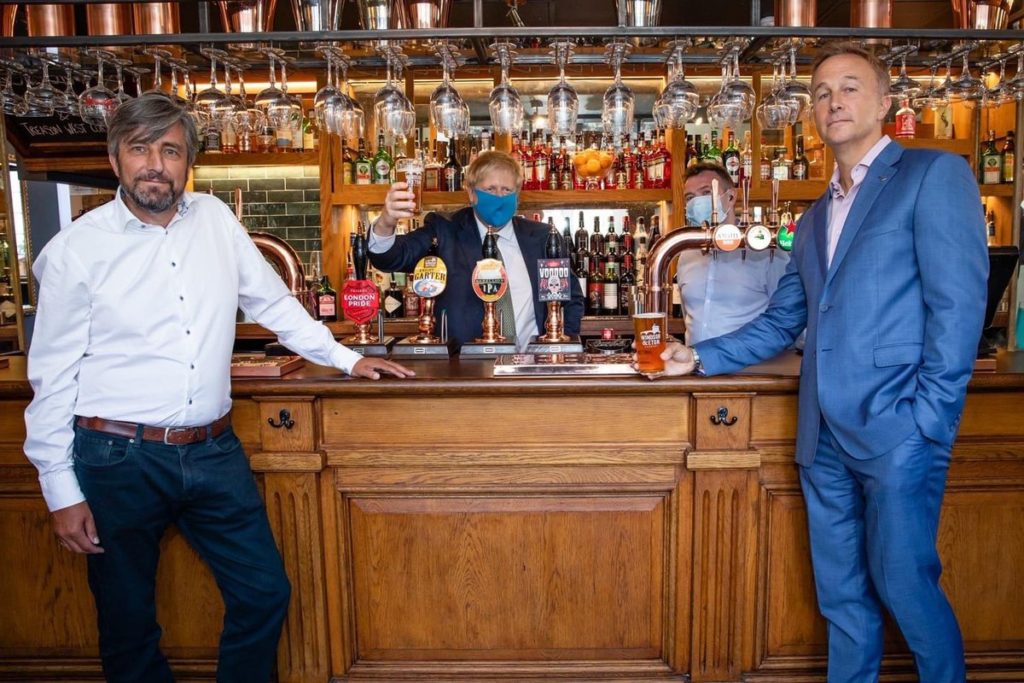
Finally, on Tuesday 23 June, Prime Minister Boris Johnson announced that pubs, bars and restaurants (but not night clubs) in England were free to reopen as from Saturday 4 July. I think that it is worth recording what led up to the announcement. There was the peddling of a bewildering amount of dubious commentary (some might say ‘fake news’), starting as far back as mid-May and most of which mentioned 4 July, a reduction in the ‘social distancing’ measures and, early on, gardens and open areas. The latter proved to be a minor red herring. None of this will have been helpful to hard pressed publicans who were just desperate for some definite news to help them keep their businesses alive.
For example, according the Daily Mail (3 June), in a bid to comply with social-distancing rules, ‘industry leaders’ were proposing that British pubs could be scrapped and replaced by Bavarian-style bierkellers, with pint glasses replaced by two-pint ‘steins’ to reduce contact with bar staff. The article said that the proposals had received the backing of the British Beer and Pub Association (BBPA), although that is not the interpretation that I put on their statement. Similarly, the Sun reported that it had seen a Government ‘secret plan’ (some secret then!).
At the end of May, the chief executive of the BBPA, Emma McClarkin, wrote to Chancellor Rishi Sunak to tell him that a poll of BBPA members indicated that some 40% of pubs could not survive until September if they remained closed and that the pub sector was ‘burning through roughly £100 million in cash every month’ during lockdown. Along with the British Institute of Innkeeping (BII) and UKHospitality (UKH), she asked for the furlough salary level for pub and hospitality staff to be maintained at 80% until October. As it happens, Mr Sunak was among half a dozen ministers who, according to the Financial Times, called themselves the ‘Save Summer Six’ and were looking at ways to help pubs to reopen using beer gardens, terraces and marquees. The FT claimed to have received confirmation of their plans from three Whitehall officials.
Eventually, on 14 June, the Prime Minister ordered a review into the ‘two metre rule’, to involve economists as well as medical scientists. This was against the background of continuing conflicting information, including a poll conducted for the Evening Standard by YouGov, the results of which were:
• It should be kept at two metre      58%
• It should be reduced to one metre   24%
• It should be scrapped altogether     8%
• Don’t know                          10%
Of course, a survey limited to those who were previously regular pub-goers would have been more informative and as it happens, CAMRA have already conducted one between 11 and 18 May. 21,941 responses were received, of which 90% were from CAMRA members. In answer to the question ‘How confident are you about returning to pubs once lockdown is lifted?’ the replies were as follows:
• Very confident                        40%
• Somewhat confident                    25%
• Neither confident nor not confident   10%
• Not confident                         21%
• Extremely unconfident                  4%
The pressure was increased on 17 June when some fifty leaders from the pub and brewery trade wrote to the Prime Minister giving him a deadline of Friday 19 for the announcement of a definite reopening date because of the mounting costs mentioned above and the effect of the forthcoming changes to the ‘furlough’ scheme. They included Young’s, Wetherspoon’s and the City Pub Group, whose Clive Watson pointed out that “we have to bring staff off furlough, we need to restock and we need to lay the pubs out in a socially responsible way”. This was followed a day later by the Oakman Inns chain threatening to reopen unilaterally. Nothing was said at the daily press briefing that Friday but, on the BBC’s Any Questions programme that night, Culture Secretary Oliver Dowden said the review on the ‘social distancing’ rules would report ‘in the coming days’. The announcement came four days later.
CAMRA’S VIEW
The Daily Mail article also said that CAMRA was in favour of the bierkeller proposal but this is what National Chairman Nik Antona actually said on 3 June, “The forced lockdown of the nation’s pubs could have a devastating impact on the industry, with estimates that up to 40 per cent of the nation’s pubs will close their doors for good. It’s therefore imperative that pubs can open as soon as it is safe to do so, and all ideas to bring this about are welcome. Having an open space where you can mingle at the bar and order drinks is an essential part of the pub-going experience as it gives visitors a chance to make friends and socialise in a common area that they don’t find in cafes or restaurants. I’d be very concerned if this intrinsic pub characteristic is removed and rationing introduced in the name of safety and it then becomes the norm in the months and years to come, forever changing the heart of our pubs. Furthermore, many pubs will be unable to reopen with social distancing measures in place and could be left behind as the situation moves forward.”
REGISTERING CUSTOMERS
Arguably the most contentious aspect of the Government’s guidance was the registration of customers. The guidance specifies that, in order to assist with the Government’s Test and Trace (T&T) programme, ‘You should assist this service by keeping a temporary record of your customers and visitors for 21 days, in a way that is manageable for your business, and assist T&T with requests for that data if needed. This could help contain clusters or outbreaks. Many businesses that take bookings already have systems for recording their customers and visitors, including restaurants, hotels, and hair salons. If you do not already do this, you should do so to help fight the virus’. Staff shift records also have to be retained for 21 days.
Pub and restaurant businesses remain subject to the General Data Protection Regulation (GDPR) which, unlike the guidance, has the force of law. BEIS promised that advice on how to register customers and still comply with the GDPR would be issued ‘shortly’ and it arrived nine days later, on 2 July. There is a lot of it and I will not go into detail but it said that, to comply with GDPR, pubs would have to rely on the basis that they have a ‘legitimate interest’ in collecting the data. It includes the following, ‘Although this is voluntary, please encourage customers and visitors to share their details in order to support T&T and advise them that this information will only be used where necessary to help stop the spread of COVID-19. If a customer or visitor informs you that they do not want their details shared for the purposes of T&T, they can choose to opt out, and if they do so you should not share their information used for booking purposes with T&T’. It goes on to say, ‘The accuracy of the information provided will be the responsibility of the individual who provides it. You do not have to verify an individual’s identity for T&T purposes’. There is no suggestion in the guidance that those who refuse to provide contact details should be denied entry, although it is open to licensees to exercise their legal right to do so, which, in effect, passes the responsibility for enforcement of the guidance to licensees, at their discretion.
The main issues are confidentially, timely deletion (after the 21 day period) and preventing the data being used or sold on for commercial purposes. CAMRA’s Chief executive, Tom Stainer, made the point that, “On recording customer details to help testing and tracing, this seems to be above and beyond what is being asked of other types of businesses. The Government need to make sure that this doesn’t disadvantage pubs and that the privacy of pub–goers is properly protected.”
A legal opinion given in the Morning Advertiser suggested that a simple piece of temporary legislation would have been simpler and more effective all round.
In the meantime, various companies have spotted an opportunity. I have already received several press releases from a variety of firms offering ‘ready to use’ ‘Apps’ for pubs.
I don’t want to make light of a serious situation but it was, as ever, neatly summed up by the Telegraph’s cartoonist, Matt. A couple are standing behind the bar of a pub. One is reading a paper marked ‘customer register’ and is saying, ‘If Micky Mouse catches Coronavirus, we’ll have to tell Lord Lucan, Adolf Hitler, Marilyn Munroe…’.
I should make it clear that in pointing out that the Government guidance is voluntary, I am not advocating that people ignore it.
PUBLIC AFFAIRS
During June, there were a number of reports of people congregating in various parks and open spaces across London to drink takeaway beer. The main problem was litter, including disposable plastic glasses with lids which go against the Government’s campaign against single use plastics. In some places these gatherings caused a public nuisance and there were stories, for example, of disgusting behaviour at London Fields. This led to Hackney Council seeking an injunction in the High Court to prevent the holding of illegal parties, the playing of music and other acts that caused offence to local residents. Hopefully, the reopening of the pubs will have brought this to an end, although, while the weather is good, some might prefer it.
FOGO
An interesting perspective on the reopening came from Charlie McVeigh, the founder of the Draft House chain. In an interview with the Morning Advertiser, he coined the expression ‘FOGO’, the fear of going out, and saw it as a major problem when pubs reopened and that the hospitality trade needed to play its part in reassuring the public that their venues were safe, without being seen to be going too fast. He said, “The biggest threat to the hospitality industry’s recovery is fear. Our messaging has got to be very careful. We need to be clear that our top priority is social distancing, the safety of staff and customers. But if we can get enough messaging out there: that it’s safe outside, that it’s our patriotic duty to go out to restaurants and pubs, that our staff are hospitality heroes, then this awful, destructive anxiety can be alleviated, and I think the Government will follow the people out of lockdown. As Churchill said, ‘we have nothing to fear but fear itself’.”
FORWARD PLANNING
Some, commendably, tried to get ahead of the game. As reported in the Observer (24 May), Tim Martin announced that JD Wetherspoon’s were to spend £11 million on adapting their outlets for reopening ‘sometime in the summer’. This makes the cost £12,687 for each of their 867 pubs. The works include screens between tables, personal protection equipment for staff and staff specially employed to police ‘social distancing’. This enabled JDW to announce on 24 June that 750 of its pubs (in England only at this stage) would reopen on 4 July. Drink and food prices were initially increased, by 10p and 20p respectively, although they were subsequently reduced (see page 22).
In June, Urban Pubs and Bars, who operate 20 pubs in London, installed a contactless temperature sensor called Foresight at the Bat & Ball in the Westfield (Stratford) shopping complex. Made by a British company called Fevershields, it is accurate to 0.2 degrees C and responds in a matter of seconds. The idea is to check each customer’s temperature as they enter and if it detects a temperature over 37.6 degrees, an alarm sounds, red lights flash and the temperature is shown on a screen. If the customer is just hot, they will be given ten minutes to cool down and then tested again.
MEANWHILE ELSEWHERE…
Guernsey was the first to reopen, at the beginning of June. Pubs were restricted to table service with tables set one metre apart and had to keep a record of customers. In Northern Ireland, the pubs were originally going to be reopened on 20 July but following lobbying from the hospitality industry, this was brought forward to 3 July. Pubs in the Republic of Ireland, after some confusion over serving food, had already opened on 29 June. In Wales, the reopening was delayed until 13 July (outside areas) and until 3 August for full reopening. In Scotland, pub gardens and outdoor areas reopened on Monday 6 July with full reopening following on 15 July. In Glasgow however, from 6 July, the city council banned the sale of takeaway beer. This followed a large number of complaints about anti-social behaviour arising from street drinking, which had been illegal anyway since 1996. The ban was specifically on drinks that were not pre-packaged and properly sealed, unlike in bottles and cans.
DISPOSAL OF OLD BEER
Happily, when push came to shove with the reopening date for pubs announced, all went well. All of the water companies waived their fees for disposing of spoilt beer through the sewerage system and the operation was carefully managed so as to avoid causing problems with the wastewater treatment processes. In the south west, for instance, this involved leaving a specific interval between each cask being poured away so as to avoid overwhelming the system and having to stop if there was heavy rain.
At one point, the Department for Environment, Food and Rural Affairs (DEFRA) was reported to be investigating alternatives such as using anaerobic digesters or using spoilt beer in the production of animal feed. I have not seen any reports that this actually happened however.
Meanwhile, in Ireland, Guinness came up with some interesting alternatives. All unused Guinness was returned to the brewery who used some of it in an experiment to see if it could produce bio-gas to power the brewery while the rest went to help fertilise Christmas and willow trees. My only thought is, who would want a black Christmas tree with white needles?
Tony Hedger