On 20 June, the CAMRA London Pubs Group visited five pubs in Tooting and Merton to see if they met the criteria for inclusion in CAMRA’s inventory of pubs with local historic interest. Just off Merton High Street once stood Merton Place, a country estate in what was then rural Surrey. It was bought in 1802 by Emma, Lady Hamilton and she lived there with Vice-Admiral of the White Horatio Nelson, the 1st Viscount Nelson. It was from here that he travelled to Portsmouth to join HMS Victory and sail to Cape Trafalgar. This history subsequently influenced many pub names in the area, as will be seen.
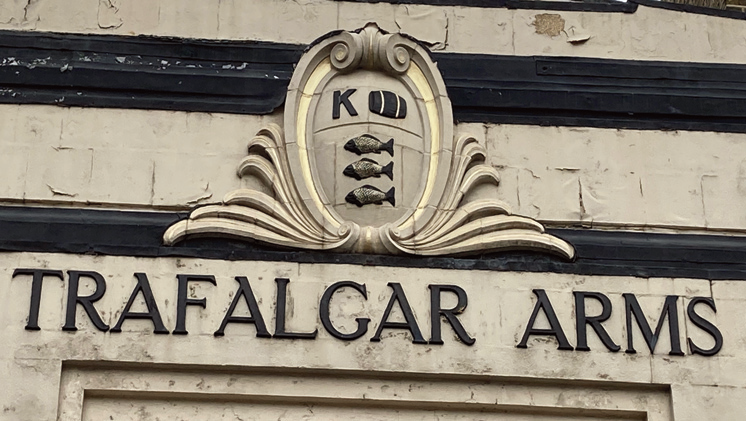
The tour started at the Trafalgar Arms in Tooting High Street. This inter-war pub is of interest due to the wonderful surviving Hodgson’s Kingston Brewery frontage. It was built by Joseph Hill in 1930 with an unusual art deco frontage featuring an egg-shell glazed faience. On the central pediment is a stone scrolled shield with the brewery’s trade mark of a ‘K’, a cask and three fishes (the emblem of Kingston also seen on the Duke of Buckingham in Berrylands). High on the front elevation on each side is relief lettering reading ‘HODGSON’S KINGSTON ALES’ and ‘HODGSON’S KINGSTON STOUT’, though sadly now obscured by modern signs. A non-original feature of note inside is a green Southern Region ‘running in board’ sign from Tooting BR station. The pub became part of the Courage estate following their takeover of Hodgson’s in 1943. Locally listed, it is now owned by Young’s who bought it in 2013 when it was closed and under threat of conversion to residential use. Timothy Taylor Landlord and Young’s London Original are normally served here.
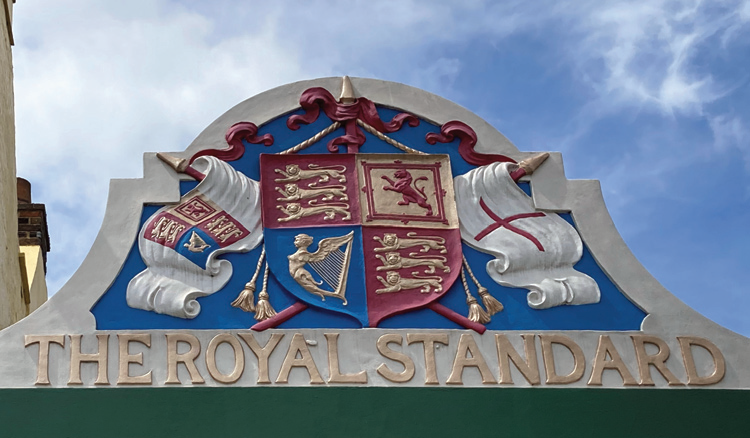
Next came the Royal Standard in High Street, Colliers Wood. This is a former Charrington house whose main point of interest is the splendid façade with its elaborate pediment over the entrance, depicting the heraldry of the Royal Standard. The pub is locally listed and is in the Wandle Valley Conservation Area. It is a continuation of the neighbouring building, forming a short terrace. The current Royal Standard of the United Kingdom dates from 1837 when Queen Victoria, being female, could not accede to Hanover under Salic law and thus the inescutcheon of the Electorate of Hanover was removed from the banner. Two Greene King cask ales are normally served here. On leaving, the tour passed what is now the Holden, originally the Victory, another Nelson connection, but the current owners changed the name (first to the Charles Holden) because of the reputation of its previous clientele.
The third stop was the Sultan in Norman Road. This is not a candidate for inclusion in the local inventory because it already has two stars on CAMRA’s National Inventory (NI), indicating an interior of very special national historic interest. It was included on the tour as an example of a NI pub. The original Sultan was destroyed in an air raid in February 1944 and the present pub, built predominantly of brick in the 1950s, is a remarkably intact survivor of that period. Originally a Friary Meux house, later Ind Coope Allied, it was rescued from likely permanent closure and redevelopment in 1994 by the Hop Back Brewery. The indications are that it was always just two rooms: public bar on the left and saloon bar on the right. A conservatory was added relatively recently. The public bar retains its original distinctive counter, although the front is now painted a deep pink, along with an original bar-back of shelves on ply panelling with some mirrored panels. Fridges have however replaced the lower shelves. Around the small room is a dado of 1950s ribbed hardboard, now painted a deep pink, and there are two small 1950s brick fireplaces.
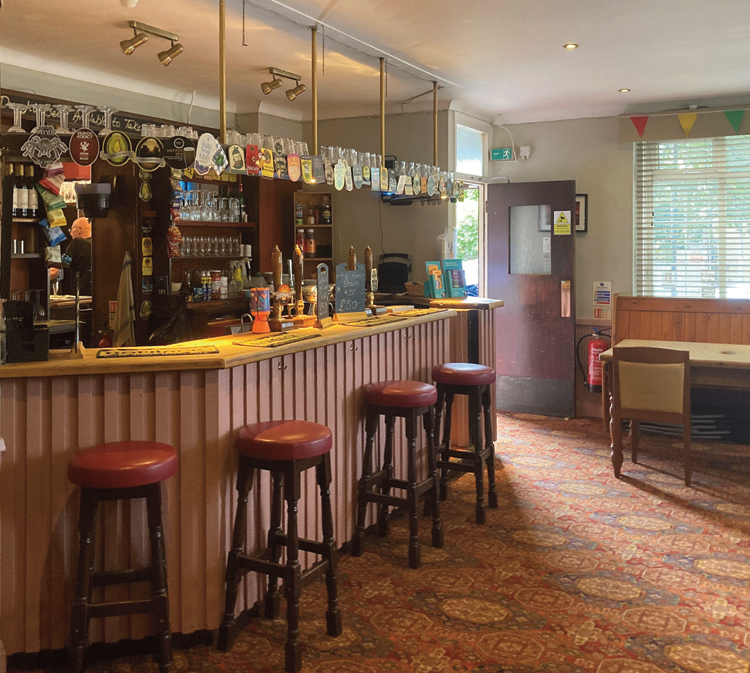
The saloon bar on the right similarly retains its original counter and bar-back with some mirrored panels. Within the back fittings there is a dumb waiter that would have been used for moving bottled beers to and from the cellar. Above the servery is a very characteristic c.1960 canopy of pegboard tiles with a 1950s ribbed hardboard edging now painted a deep pink. There are three small 1950s brick fireplaces and the room has two types of panelling. There are tall ply panels reaching to picture-frame height either side of the servery and around the rear right fireplace; elsewhere, there is a dado of 1950s ribbed hardboard now painted a deep pink. The pub’s inn sign from 1994 is on display. This suggests that the pub is named after a horse but old photos show signs bearing the visage of a stereotypical middle-eastern potentate, an image that might perhaps prove problematic today. The pub is in the Good Beer Guide 2026. Hop Back GFB, Summer Lightning, Citra and Entire Stout are regular beers, along with Hop Back seasonal beers and a changing Downton beer. Two ciders are usually available on handpump.
Next, continuing the Nelsonian theme, was the eponymous Nelson Arms in Merton High Street (SW19 1DF). already on the local inventory and boasting probably the most intact and spectacular Charrington’s Brewery pub exterior in London. This corner pub features a turret and there is trademark Charrington brown tiling on the ground floor, with bowed windows on two sides. Set within the tiling above the bowed window on the Merton High Street side is the name of the pub and elsewhere the tiling includes ‘CHARRINGTONS’ and ‘ALES AND STOUT’.
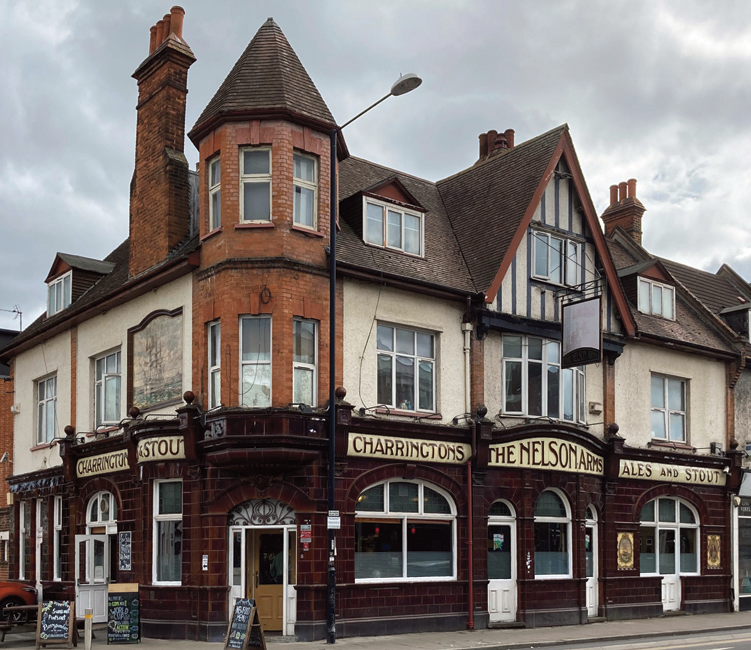
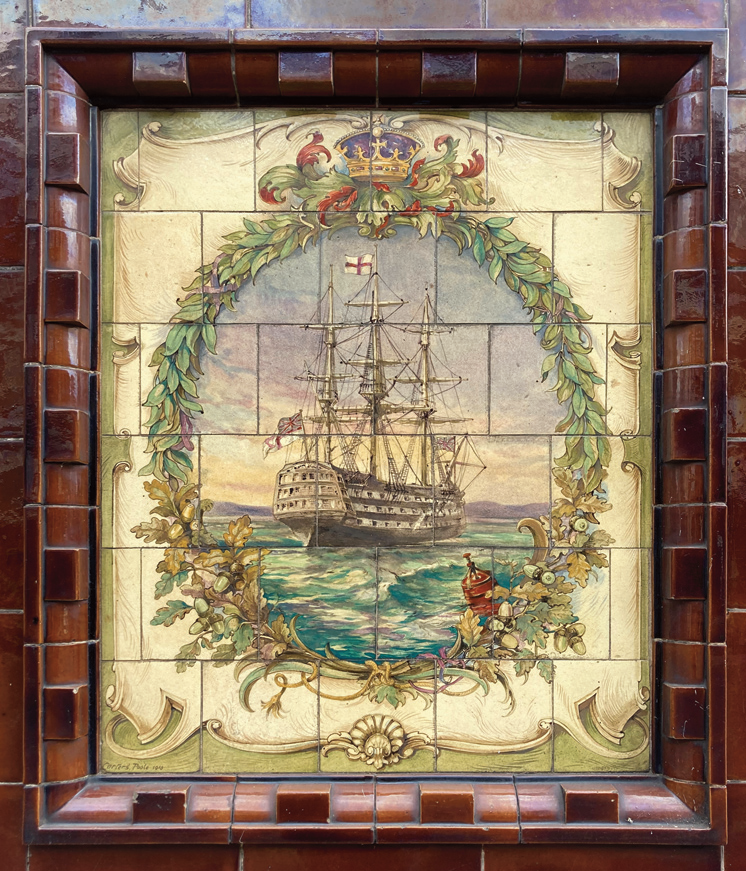
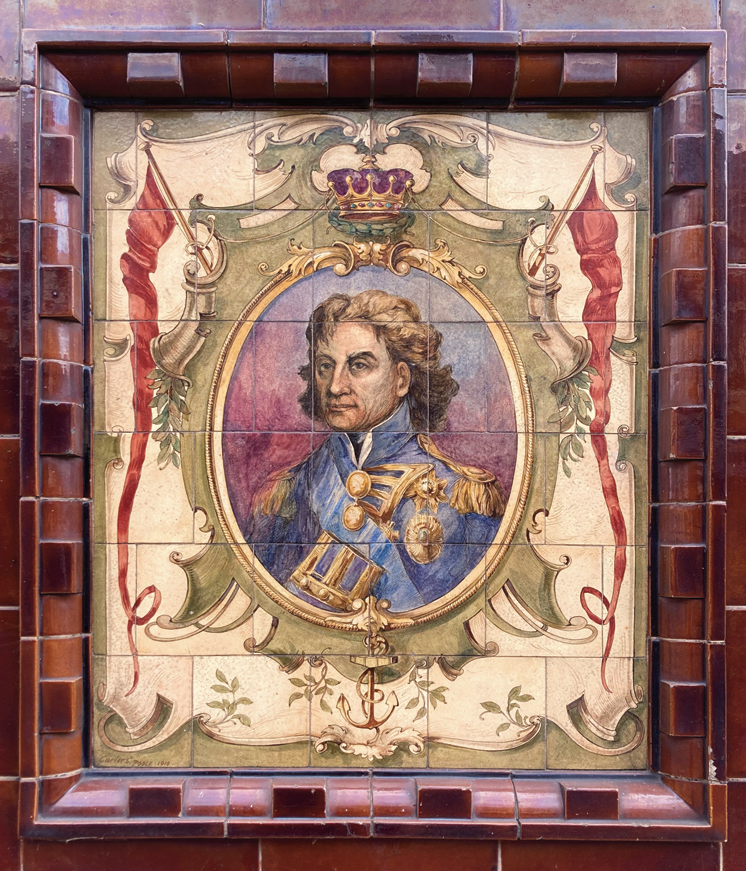
However, the most striking external feature is the trio of painted tiled panels. All three are signed ‘Carters, Poole 1910’, a well known tile manufacturers who lasted until 1964. The large one on the first floor of the Abbey Road side depicts HMS Victory while the pair on the ground floor on the Merton High Street side are of HMS Victory and Lord Nelson himself. Cask ale is not available here.
The afternoon finished in the Trafalgar in High Path. Although this pub is neither a statutorily or locally listed building, nor in a conservation area, it was included on the tour as a good place to finish, being CAMRA South West London Branch’s Pub of the Year. Last year it was also the branch’s Cider Pub of the Year. One of the last remaining buildings of any character in the area and now documented as a non-designated heritage asset. It has been under threat of redevelopment but there are plans to preserve it for the community. The pub retains a small fragment of typical green and orange Charrington stained window window glass, plus a very rare 1970s exterior name sign using white serifed lettering on a black rectangular plastic box. It is in the Good Beer Guide 2026. A range of changing cask ales from small breweries and four ciders are normally served here.
Jane Jephcote and Kim Rennie