In this edition we remember three people who have each played a part in London’s pub and beer history in their very different ways.
Rob Jones, who has died aged 69, was one of the pioneers of independent brewing in London. He first came to prominence as one half of the Pitfield Brewery partnership with Martin Kemp. In 1987 their Dark Star, a 5% ABV old ale, won CAMRA’s Champion Beer of Britain award. They were the first ‘micro’ to achieve this. Set up in 1981, they were based in the Beer Shop off-licence in Hoxton, with the brewery in the basement until demand required a move to some former stables nearby.
When the partnership ended, and after spells brewing for other people, Rob set up his own brewery, called Dark Star (he had retained the rights) in the basement of the Evening Star in Brighton. He created a pale ale called Hophead (3.8% ABV), brewed with Amarillo and Cascade hops. The effect that this beer had on the trade cannot be underestimated. With the help of Mark Tranter, whom he met at the Evening Star, Rob expanded first to a site at Ansty and then to a purpose-built brewery at Partridge Green that had a capacity of 20,000 barrels a year. Several other beers were added, such as the award-winning American Pale Ale and my particular favourite, Revelation.

Rob left Dark Star before Fuller’s acquired the company in 2018. Fuller’s appeared happy to leave them to operate independently until they themselves were taken over by the Japanese brewer Asahi in 2022. One of Asahi’s first actions was to close the Partridge Green site. Happily, Mark Tranter, who by then had worked for Dark Star for 17 years, kept the spirit going by founding the Burning Sky brewery at Firle in 2013.
Rob had decided to become a publican and acquired the Duke of Wellington in Shoreham-by-Sea (BN43 6RE). He turned the pub around, greatly increased its beer range and held regular festivals. His plans to brew at the pub never came to fruition but he did establish close ties with Downlands brewery in Small Dole.
It is difficult to know what to say about Humphrey Smith, the chairman of Samuel Smith’s Old Brewery in Tadcaster, Yorkshire. One Facebook post described him as ‘An absolute titan of the British brewing world’. I suspect that not everyone will be so kind. Another source described him as a ‘Christian traditionalist’, very much influenced by his grandfather who had been Bishop of Selby. He kept his and his company’s affairs very private. In 1982 he took the unusual step of changing its status to an ‘unlimited company’, which means that while its owners became personally and fully liable for any company debts, the company was no longer required to publish its financial accounts. The company produced as much of its stock (soft drinks, crisps, etc) as possible in house so as not to have to buy them from other suppliers.

Humphrey is, of course, best known for the rules that governed his pubs. Mobile ‘phones and similar devices are banned and no music allowed. There is a certain irony that most people would have learned of his death on their mobile ‘phones. Foul language is particularly frowned upon. The business was his and he ran it – and its pubs – his way; take it or leave it. Many people approved. There were questions over his employment practices and the management of the company’s estate, with a large number of pubs being kept empty, but that never troubled him.
It was reported at the end of 2024 that Humphrey was retiring and that his son, Samuel, was taking over as chairman. This seems never to come about but presumably will do so now. For some years, Samuel has been running their London pubs as a separate entity from the main estate and has not enforced his father’s rules quite so stringently. We send him our condolences and wish him well.
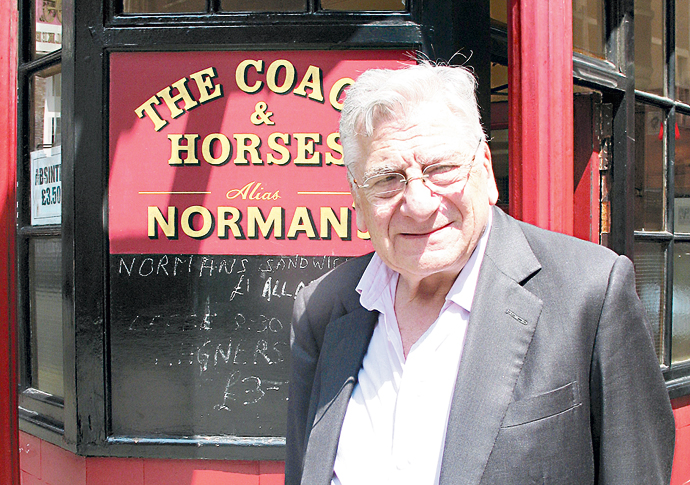
I suspect that Humphrey might not have got along with Norman Balon, who ran the Coach & Horses in Greek Street, Soho from 1943 to 2006. Norman, who has died aged 99, was legendarily London’s rudest landlord. He was very much part of the ‘old’ Soho, with the pub being used by Private Eye magazine for its lunches and its being frequented by the likes of Jeffrey Barnard, famous for his Low Life column in the Spectator magazine, and who was the inspiration for the play Jeffrey Barnard is Unwell. Underneath the bluster, Norman is said to have had a kind and generous nature and looked after his friends.