Allsopp’s to grow
Jamie Allsopp’s venture goes from strength to strength, with strong trading over the Christmas period at their pub, the Blue Stoops in Kensington. A second pub is now a possibility. Meanwhile, their association with the Kirkstall Brewing Co in Leeds, where the Allsopp’s beers are brewed, has been strengthened with the setting up of a London based joint sales team. Sales in the free trade have increased accordingly.
Br3wery expand
The Beckenham based brewers have announced that they are to open a third taproom, this time some way from their home territory. It is in Moyser Road, Furzedown and replaces an Italian restaurant called Belgiardino. It is due to open in late February. Pizzas will be available. Their two existing premises are more local in Kelsey Park Road and Beckenham Road.
Fuller’s Original
The organisation World Origin Site seeks to record ‘the place, people and moment when something truly ground-breaking was invented, discovered or first used’. Although it is a private body, it is approved by the Government’s Intellectual Property Office. WOS have recognised the Griffin Brewery as one of their sites and a plaque was recently unveiled there to mark the event. It coincides with the brewery’s 180th anniversary. There is, incidentally, still a shop at the site in Chiswick Lane South.
London Beer Factory in the Hole
The London Beer Factory has also opened a third outlet. This time however it is a well known existing pub. The Hole in the Wall just outside Waterloo Station was a pioneering cask beer outlet in the 1970s, selling the likes of Everards and King & Barnes, beers rarely then seen in London. Ed and Sim Cotton, the founders of LBF, said, “We’re thrilled to be taking on such a legendary London boozer. Our plan is to give it a more modern, premium feel, introduce a kitchen serving some of the best burgers in town, and of course, keep the incredible beer selection the pub is famous for.” LBF also operates the Barrel Project in Druid Street, Bermondsey and the Grade II-listed Ten Bells in Spitalfields.
Award for Sambrook’s
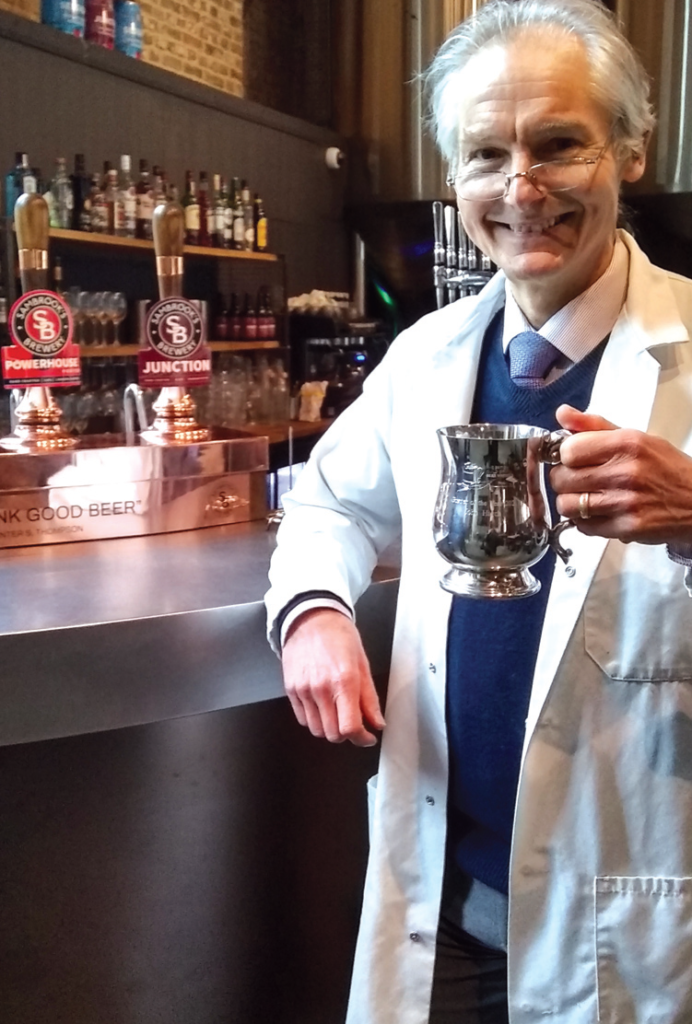
Sambrook’s Heritage Centre, lovingly curated by the legendary John Hatch, has won another award. This time it was for ‘The Best Told Story’, presented by tourist body Visit England. This follows the Heritage Centre winning their ‘Hidden Gem’ award last year. John said, “I really enjoy conducting tours of the Heritage Centre and to get these awards for doing something I love is very exciting.” Sambrook’s occupy part of the site in Wandsworth once used by Young’s and it is the longest continuous brewing site in the UK, something to which John made a significant contribution. As well as tours, John also offers ‘Brewer for the Day’ events. For more information, please visit www.sambrooksbrewery.co.uk/pages/tours.
Big brewery news
The latest major national brand to have its ABV reduced is Foster’s, going from 3.7% ABV to 3.4% ABV. Curiously, the brand is actually owned by the Japanese multi-national Asahi, who also own Fuller’s, but production is mostly licensed out. In the UK, which is its biggest market, it is licensed to Heineken and produced at the Royal Brewery in Manchester.
Heineken also own the Murphy’s stout brand, which is still brewed in its home town of Cork, and have recently been promoting it in the wake of the rise in popularity of draught Guinness. It is said to be lighter and less bitter than the ‘black stuff’. There are now over 1,500 pubs in the UK that stock it. Heineken also own the Beamish and Crawford stout brand, which similarly hails from Cork and is now produced alongside Murphy’s. However, they choose not to promote it, with most of its sales being local.
Meanwhile, in Magor, Wales, AB InBev, in the guise of the Budweiser Brewing Group, are concentrating on alcohol free beers. They have opened a new £3.9 million de-alcoholisation plant that will be used to produce brands such as Corona Cero and Stella Artois 0.0 instead of importing them from Belgium. The process to be used is called vacuum distillation. The beer is placed under a low pressure to reduce its boiling point. This causes the alcohol to evaporate but does not affect the flavour. AB InBev say that this is the only method that produces completely non-alcoholic beer.
Welcome to Wolverhampton
This may not be directly connected to London but I think readers will be happy to learn of this promising news. The closure of Banks’s Park Brewery hit Wolverhampton hard, both economically and spiritually. The mood has however been lightened by the opening of a new brewery, Springbanks. The company aims to put ‘Wolverhampton beer back where it belongs: front and centre’. It is based in a listed building dating from 1870 that was originally built for a firm of safe and lock-makers. As may be guessed from the name, as well as replacing, if not necessarily replicating, Banks’s beers, Springbanks intend also to reflect the heritage of the former Mitchell & Butler’s Springfield Brewery, which closed in 1991. To this end they have asked local residents to donate memorabilia from both breweries. Springbanks plan to brew a range of cask ales, craft beers, stouts and lagers, plus zero-alcohol beers. The first beers should be available at the end of March.
Readers may recall that, as well as the set of Burton Union equipment that Thornbridge Brewery are successfully using, Carlsberg Britvic donated another set to a brewery in Edinburgh. Unfortunately, that brewery has closed and the landlords of their former premises want the site cleared. There was a danger that the set would go for scrap but Springbanks have stepped in to rescue it. It may be some time before they can put it to use but at least it is now safe.