walk close to London’s riverside immediately to the east of Tower Bridge offers a curious mix of pubs. Of course, there’s a couple of picturesque Thames-side inns that attract tourists like wasps to a beer garden but there are also unreconstructed traditional back street boozers, ale served in uniquely historic venues and a liminal hinterland between the City and the East End where the pubs change radically according to day and time of the week. I organised a social in this fascinating area for CAMRA’s Central Southern region and walked between all the pubs on two separate Saturdays, firstly for research purposes and again for the event itself.
The walk starts south of Aldgate in an intriguing area on the edge of the City of London where new buildings housing financial businesses are set literally across the street from virtually unchanged parts of the old East End. There are a surprisingly large number of pubs due to the custom of City drinkers during the week, although at the weekends they cater mainly for locals. The sense of being in the borderlands is underlined by CAMRA’s WhatPub website listing pubs barely yards apart being divided between three different localities.
I started out just after noon on a Saturday in the Brown Bear on Leman Street, which is in an area called Goodmans. It’s a convivial old school boozer overshadowed by the elevated DLR and Fenchurch Street railway lines. Customers drifted in slowly as Saturday lunchtimes aren’t the busiest times for pubs in this area. Many further towards the City, and reliant on financial worker trade, are shut at the weekend.
Throughout planning of the trip, I referred to Alistair von Lion’s excellent book East End Pubs, with superb photography, published last year by Hoxton Mini Press. According to East End Pubs, the Brown Bear is a place where ‘the social history of the East End oozes from the ground’. The pub is close enough to the old East End to draw in a steady custom of local drinkers at the weekend. When I visited, Timothy Taylor Landlord and Black Sheep Bitter were on draught. Its Edwardian interior is highly rated by the local CAMRA branch.
On the other side of the railway lines, just off Cable Street and past the museum dedicated to the notorious (and, around here, ubiquitous) Jack the Ripper, is the legendary Wilton’s Music Hall. It is in Shadwell according to WhatPub.

This nineteenth century building was restored over a long period from dereliction. Both the music hall and the bar have been renovated using a policy of ‘conservative repair’, which means that, after restoration work is completed, areas of the building are left undecorated with a unique ‘stripped down’ appearance that’s a little reminiscent of the façades of ancient monuments. It’s principally a place to see shows these days but non-theatregoers can visit the Mahogany Bar, which is open to the public prior to matinee and evening performances.
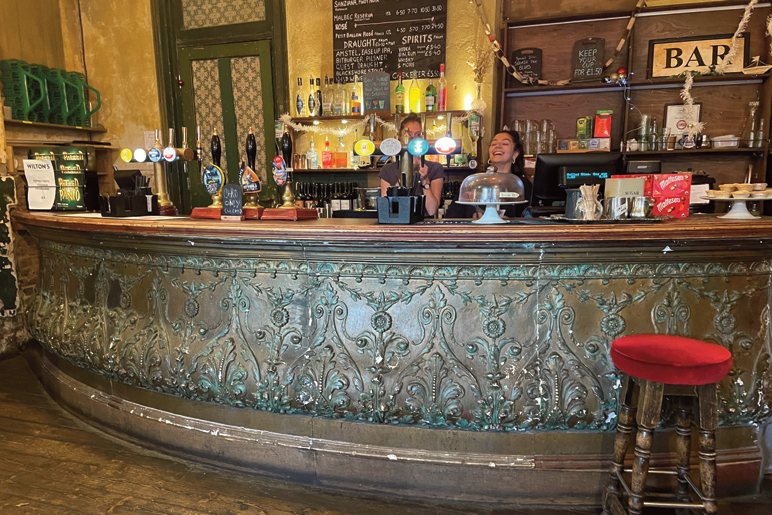
As well as the impressive architecture, the bar serves real ale (or aims to). On one visit there were three well kept Adnams beers available on handpump. On a second visit, on a Saturday evening, disappointingly they had run out of cask ale completely.
Around the corner on Dock Street, in Tower Hill according to WhatPub, is a pub with the atmosphere of a local far removed from the global financial centre up the road. The Sir Sydney Smith is a friendly place with a front bar facing on to the street and, tucked behind the servery, a back bar with bare brick walls and dartboards.
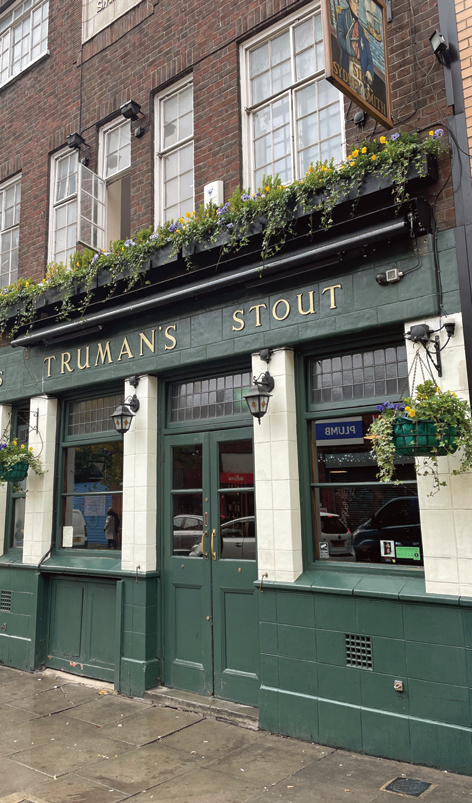
The walls are lined with photographs detailing episodes from the local area’s rich history. The pub itself is over two hundred years old. On my two visits I drank Deuchars IPA from Belhaven (Greene King) and Stiff Upper Lip from By the Horns Brewing Co.
Heading towards the river and crossing the busy junction with the Highway, the area changes from narrow, crowded streets to relatively recent redevelopment. This is close to the site which most people of a certain age associate with the name Wapping: the infamous News International Wapping plant built in the late 1980s, although now also demolished. When the nearby St Katherine’s and Wapping Docks were in their heyday this locality was dominated by warehouses and probably boasted a fair few pubs, all now long gone.
The walk along Vaughan and Thomas More Streets must be one of the most publess parts of central London (don’t worry, we will make up for it later). If you’re very thirsty, there is a pub of sorts hidden within the Waitrose shopping centre complex on the left: the Moretown Belle. It’s a curious place with staff on the doors, even on a Saturday lunchtime. Inside is an enormous, modern space with super-gigantic TV screens showing sports. There was a choice of one real ale, Fuller’s London Pride. It was in decent condition although the staff were rather keen on delivering it via table service. Not far away is the unashamedly touristy Dickens Inn in the regenerated St Katherine’s Dock.
The Thames is only a short walk away with the Blitz memorial in Hermitage Riverside Memorial Garden at the end of Wapping High Street. From here, the Town of Ramsgate is a five-minute stroll east along the river. The pub is Grade II listed and East End Pubs reports that it is ‘believed to be among the oldest pubs on the Thames with records going back to 1545’. It also has spectacular riverside views and is located next to Wapping Old Stairs, which used to lead to ferries which, hundreds of years ago, were used to cross the Thames. There are also rumours the pub’s cellars used to house prisoners awaiting transportation to the British colonies.
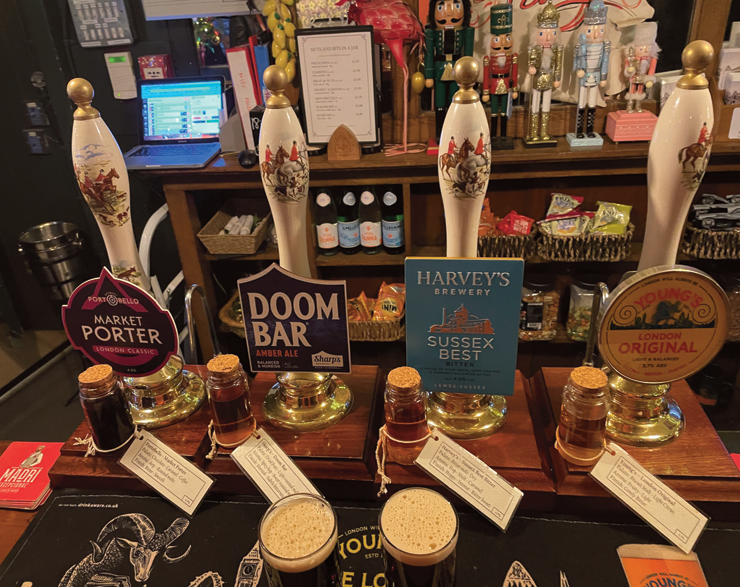
The spectacular view that I was most interested in was of the bar’s four handpumps. I partook of a Harvey’s Sussex Best, although Portobello Porter and Young’s Ordinary were also within sight. It’s a long thin pub with a bar on the left as you enter and has a warm and lively atmosphere. Unfortunately, I missed the ornate barometer mentioned in the Good Beer Guide.
We continue into the heart of Wapping in Part Two in the next edition.
Mike Clarke
(An account of the same walk has previously appeared in Swan Supping, the magazine of CAMRA’s Aylesbury Vale and Wycombe branch.)