On the evening of Wednesday 14 December 2022, CAMRA’s London Pubs Group entered ‘Bal-ham’s thriving community’ on their latest tour.
‘Broad bosomed, bold, becalmed, benign; lies Balham, foursquare on the Northern Line’. So claimed writers Frank Muir and Denis Norden, as voiced by actor Peter Sellers, in a parody travelogue called ‘Balham (Bal-ham) – Gateway to the South’ included in an episode of the BBC radio series Third Division in 1949.
We started at the Avalon (16 Balham Hill, SW12 9EB). Formerly the George, this ex-Courage house is a large, handsome pub, allegedly a former coaching inn. Inside, it has been opened out and modernised, with plain tiles on the walls and a Burne-Jones style mural depicting an Arthurian scene. The large dining room at the rear, previously used for concerts, has two plain skylights and this may have once been the billiard room. Sharp’s Doom Bar and Timothy Taylor Landlord and Golden Best were being served here on the night.
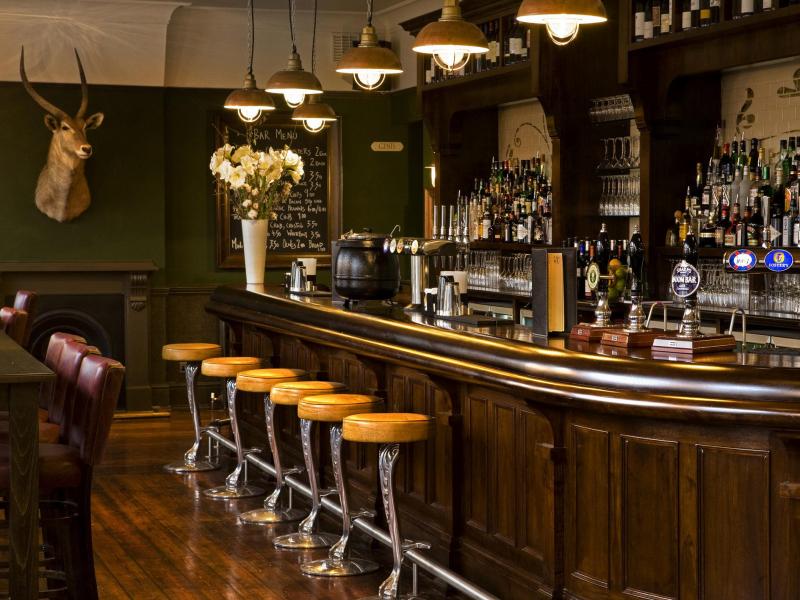
A walk down Balham Hill and a right turn into Oldridge Road led to the Grove (39 Oldridge Road, SW12 8PN). Built between 1873 and 1877, this former Young’s pub is named after a house that preceded it. CAMRA’s mid-1980s Real Beer in South-West London praised its ‘convivial public bar’, while Young’s official guide, Inn and Around London (1991), describes it as having ‘altered very little in appearance’. Alas no more; little remains of a once splendid interior. There are vestiges of its former glory, such as the ornate plasterwork and the (now modernised) skylight. Other detrimental changes are the removal of carpets and sections of wall plaster to expose brickwork, plus liberal applications of the dreaded ‘gastropub grey’ paint. The usual Young’s range of Original, Special and St Austell Proper Job was available.
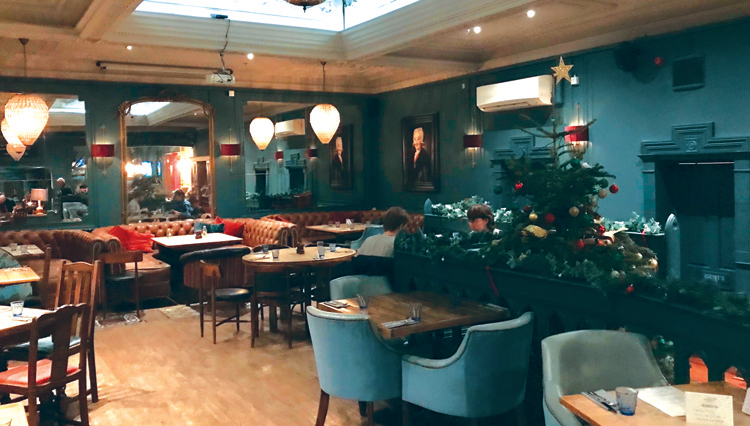
From here the group retraced their steps to Balham High Road, turned right, and continued down to the Devonshire (39 Balham High Road, SW12 9AN). Formerly the Duke of Devonshire, it started off as a beer house leased from the ducal estate, before being bought outright by Young’s in 1925. The pub is on CAMRA’s London Inventory of Pub Interiors of Some Regional Importance which states, ‘This is a substantial brick, corner-site pub, probably refitted in the late 1890s when, no doubt, the pink granite facing was fitted on the ground floor. There has been a great deal of opening out and replacement of fittings internally such as the modern bar counter in the rear section and the modern pewter-style bar top throughout but this pub is included here for the startling and impressive amount of high-quality glass’. Notable also is the grid design of the ceiling throughout. Several participants bemoaned the fact that the amount of glass, dark varnished wood and screening seems to have reduced on their every visit over the years. The same selection of ales as at the Grove were on offer, plus the seasonal Winter Warmer.
The tour left the pub just as Morocco exited the World Cup and, during the evening, the deployment of ‘big screen’ TVs was perhaps not overly conducive to appreciating pub architecture.
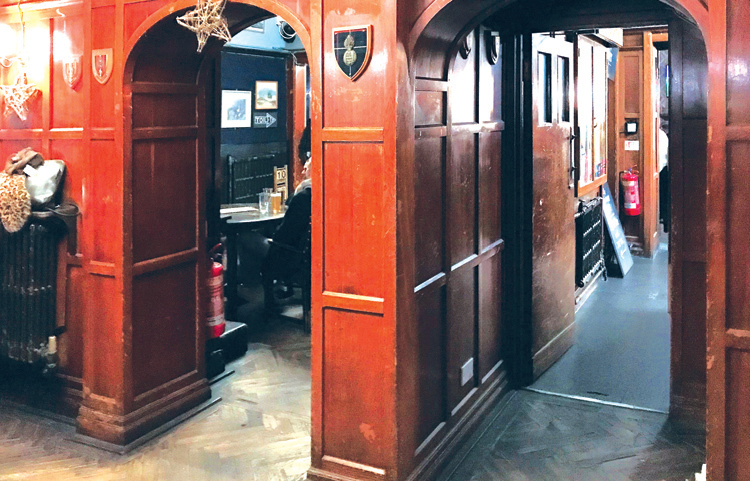
Continuing down Balham High Road and cutting through Waitrose’s car park to Ramsden Road brought the party to the Balham Bowls Club (7-9 Ramsden Road, SW12 8QX). Now operated by Antic, the pub is also on CAMRA’s London Regional Inventory. Originally the Balham Club, then Balham Bowls Club (its bowling green was later sold off), this became a pub in 2006 and has a multi-roomed interior with lots of inter-war fittings. From the front door a passage with fielded panelling turns to the left into the public bar. This has a parquet floor and a curved fielded panelled bar counter. There is a bell box with club-like room names such as ‘Concert Room’, ‘Billiard Room’, ‘Card Room’ and ‘Board Room’. A wide wooden panel-lined arch at the back of the public bar leads to the rear room which has a parquet floor and lots of quality wooden panelling on the walls. The front right room was the billiards room and still retains some raised fixed seating in the front window area. The lighting structure that hung over the table is now a feature on the wall. Dado panelling runs all the way up the staircase to the first floor where there is a large concert room with a segmental barrel-vaulted ceiling. A typical Antic Pubs selection of Thornbridge Jaipur and Volden Pale and Session is normally served.
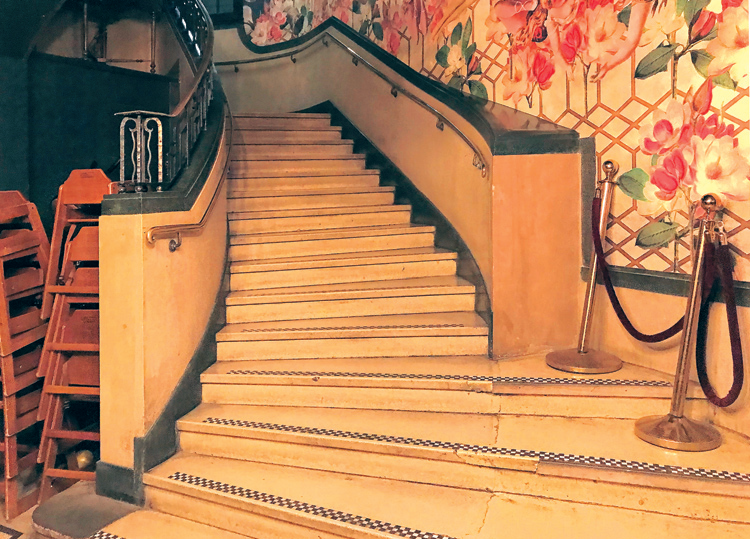
Turning right out of the pub, back to the High Road and up Balham Station Road brought us to Bedford Hill and the Bedford (77 Bedford Hill, SW12 9HD). Originally the Bedford Hotel, it was built c.1931 as an ‘improved’ public house by A W Blomfield for Watney Combe Reid & Co Ltd. It is Grade II listed. It replaced an earlier public house from the 1870s that had been constructed when the local residential area was being developed. Designed to occupy a tight corner site, the present pub exemplifies the character of the inter-war ‘improved’ public house. As built, it had an ensemble of first-floor function rooms and ground floor bars of varying function and status. The impressive double-height circular lounge (now called the Shakespearean Globe Theatre) features a domed roof. Today the building is little altered externally, while internally the former public bar, main stairs, first floor function rooms and lounge retain many of their definitive fixtures and fittings. The rebuilt Bedford Hotel was an ambitious project; the tender for the building work came to £30,000, a substantial amount, almost four times the average cost of an inter-war pub, reflecting the wealth of facilities it offered. The public bar has an entrance on Fernlea Road and a second public bar, described as a private bar, on the corner, has an entrance on Bedford Hill.
These and the separate saloon bar to the south are all served by a central service area with a small office behind. These three rooms are now combined into one L-shaped space, although, confusingly, the former public bar area is now lettered as the saloon. There was a separate off-sales shop on the left of the Fernlea Road elevation, adjacent to the garage, which was linked to the service/private area of the pub. The grander of the two entrances on Bedford Hill once gave access via a lobby to the saloon bar and to the lounge and to the main stairs that gave access to the first floor function rooms. Above the former saloon and private bars was a club room and/or ballroom, while on the pub’s north side, above the public bar, were an ante-room and buffet, the three rooms all inter-linked and forming an entertainment suite. Each had a door opening onto a triangular crush hall at the head of the stairs. A further two floors above contained staff accommodation.
Watney’s were the leading pub improvers of the time, undertaking 285 building/rebuilding projects between 1918 and 1939. A W Blomfield (1879 to 1949) was their assistant architect from 1919 and held the post until his retirement just before the Second World War. A versatile architect, his work included the Horns, Shoreditch (now a private club); the Mitre, Holland Park; the Mail Coach, Uxbridge Road (demolished); the Angel, Edmonton (demolished); the World Turned Upside Down, Old Kent Road (now flats) and the York Minster, Dean Street (now the French House).
The Bedford proved a suitably climactic and spectacular venue for participants to finish the tour in and, upon leaving the venue, the glittering night lights of Bal-ham could once more be admired: Green…amber…red…red and amber…and back to green…
Kim Rennie and Jane Jephcote
Note: the Balham sketch was subsequently included on the 1958 Parlophone long-playing record The Best of Sellers, produced by George Martin.