There are no pineapples at Wimbledon Brewery – but there is juniper!
But the brewery’s story began some years ago at a breakfast in 2014. Mark Gordon, who worked in the City, had a burning desire to set up a brewery. Having put himself through a course at BrewLab, he needed some advice on where to start. After doing some research, Mark arranged to meet John Hatch (winner of the John Young Memorial Award) to explore the options. John recommended that Mark get some professional help and suggested John’s former colleague at Young’s, Derek Prentice.
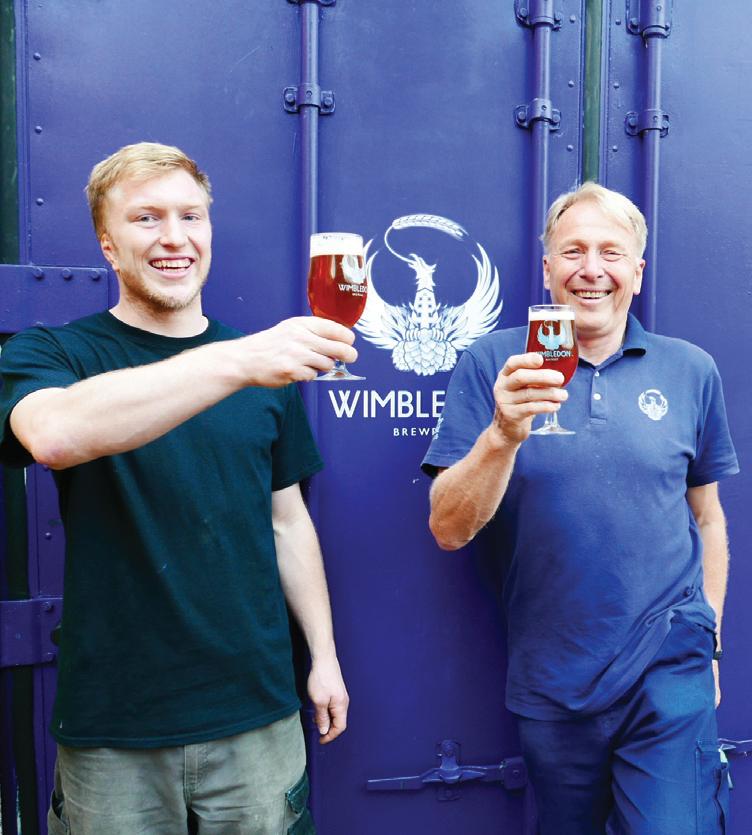
At the time, Derek was doing some teaching but was happy to help Mark and from a couple of initial conversations, Derek’s involvement grew. During the summer of 2014, Mark was actively looking for premises around the SW19 (Wimbledon) area. It took about six months to find somewhere and design and install the kit.
The brewery opened in time for the tennis championships in the summer of 2015. Their beer was launched at the first Wimbledon FC Beer Festival with their standard bitter Common. “It was born in South London” said Derek. “We named it in light of the fact that it was not an ‘ordinary’ bitter but also in homage to the Wombles.
The initial range was expanded with the addition of two more British style beers: Tower, a stronger bitter named after the fact that the original Wimbledon Brewery was a tower brewery and Quartermaine IPA. Derek explained, “This beer is named after one of the original owners of the brewery, which burnt down in 1889. It was opposite the Dog and Fox on Wimbledon Common. As the brewery burnt, the liquor tank in the roof collapsed and put out the fire but the horse drawn fire engine couldn’t get up the hill to help. It had been wet and the water froze, making it too slippery.” And that explains Wimbledon’s logo. It incorporates, the fire, the tower brewery and hop cones. “It’s definitely hops and not a pineapple!“ said Derek.
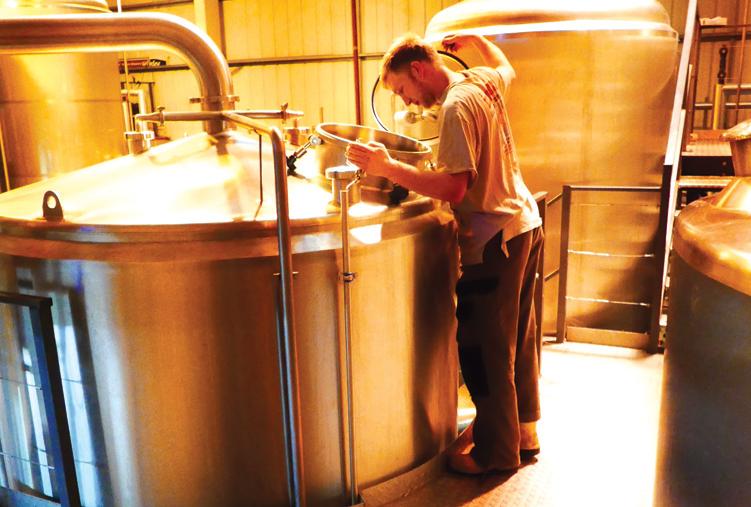
Needless to say, Derek takes his ingredients very seriously. “We use Maris Otter malt in the Common. Malt quality plays a bigger part as you go down the gravity band because you notice the malt flavour more. Maris Otter barley was bred for brewing.” Derek then went onto explain the hops in this beer, “We wanted a classic British hop character so we used Fuggles and Goldings, overlaid with Target for its bitterness. It brings in an English hop flavour but it can be harsh for bittering.”
When Derek was at Young’s (he was second brewer to Ken Don), he pushed dry hopping for Special and Ram Rod. “Nowadays, at Wimbledon, we dry hop in the vessel towards the end of the fermentation rather than in the cask. When the carbon dioxide builds up in the container, if we dry hop, the debris causes flocculation.”
Derek also reflected on his time at Truman’s, prior to his joining Young’s. “They were major producers of keg beer but, before their end, they went into cask, including wooden barrels. They were probably the biggest producers of cask beer in the country at the time.” Truman’s produced three regular beers: Green (bitter akin to Young’s Ordinary), Red (akin to Young’s Special) and Samson, with a black label, akin to ESB.
Wimbledon has no problem with mixing old brewing techniques alongside the new. Quartermaine IPA is the bigger brother of Common and they are brewed using the parti-gyle method. This involves producing a strong mash and then splitting it, with some going on to produce the stronger beer and the rest diluted to produce Common. Both use the same hop blend. This approach has been used for centuries. The cask version of Quartermaine is 5.5% ABV but the bottle conditioned version (called just Wimbledon IPA) is a mighty 6.2% ABV, and accounts for two thirds of sales. The beer is initially filtered and then fresh yeast added to consume the oxygen in the bottle. Wimbledon also produce a summer beer, SW19, which uses a blend of British and American hops (Fuggles, Goldings, Mosaic and Cascade) and a winter beer, a porter, called Phoenix, at 4.8% ABV.
Like a lot of London breweries, Wimbledon have been growing. Their brew length remains at 30 barrels, still using their original custom built plant but they have gradually increased the number of fermenters and conditioning tanks; they currently have four 30 barrel and three 60 barrel fermenters and three 30 barrel conditioning tanks. In addition, they have a large Wimbledon branded storage container that sits alongside their outside drinking area. This has freed up some space on their mezzanine for inside seating for the tap room and to help develop their on-sales.
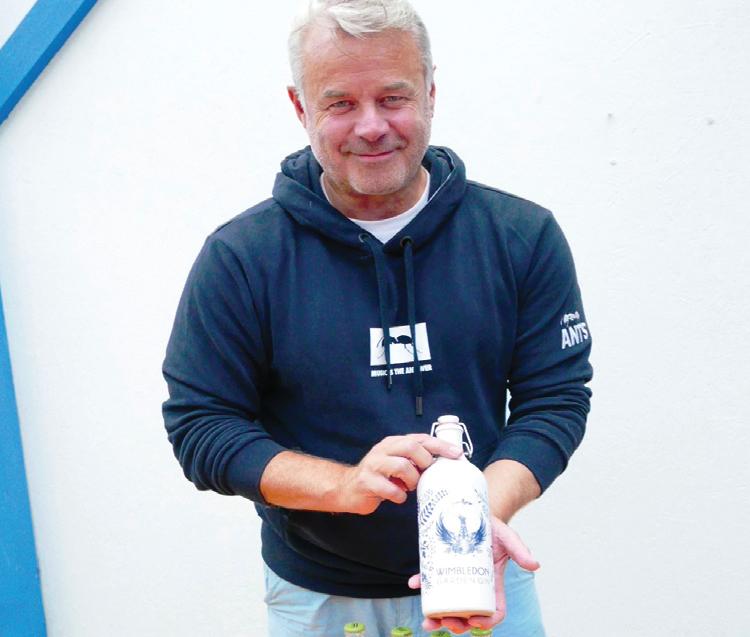
Although Derek said, “We want to be recognised as a premium brewing company producing cask beer and good beer!” beer isn’t the only product in their portfolio. As well as liking his beer, Mark likes his gin and started producing his own in November 2020. Mark enthused, “It’s a small batch gin, using local honey and botanicals typical of the Common, such as gorse and heather alongside the juniper and we have added in Cascade hops and lemon.” Called Wimbledon Garden Gin, the 43% spirit is sold in a swing top bottle which means it can be refilled and it is going down a storm. Mark said, “It won Golds in the Global Gin Masters in 2020 and the San Francesco World Spirit Competition 2021.”
So whether you are talking about beer or gin, there is always a homage to the local at this South West London brewery and not a pineapple in site!
For tasting notes, see the brewery page on the regional website and follow the links.
Christine Cryne