The second CAMRA London Pubs Group tour of 2021 took place on Saturday 16 October and visited four historic pubs in Dagenham and East Ham.
First was the Eastbrook, at the junction of Dagenham Road and Rainham Road South, Dagenham (RM10 7UP). This long-standing free house was built in 1937/8 for wine merchants and off-sales proprietors G A Smith and W Dunning. It was designed as an ‘improved’ public house, serving the rapidly expanding suburb of Dagenham.
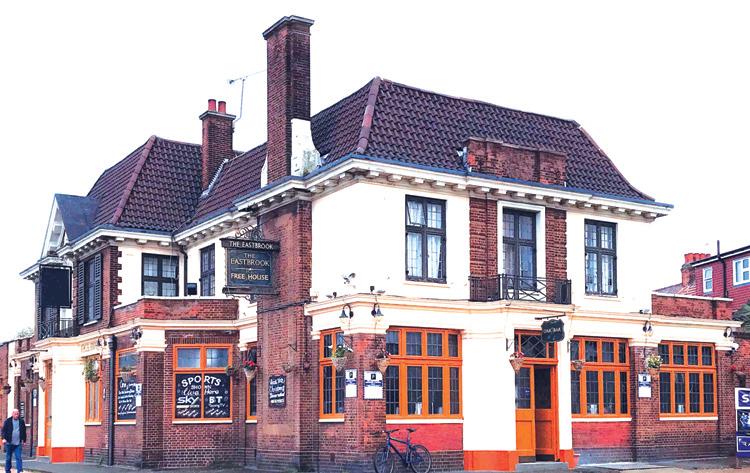
Such establishments, built in great numbers between the wars, rejected the flamboyant architecture, brilliant décor and small bar layout of the late Victorian ‘gin palaces’. Instead they aimed to encourage sensible drinking and to attract respectable customers by offering vernacular or Neo-Georgian exteriors and open plan interiors. The architecture here makes considerable play of panels of brick alternating with render and hipped roofs with pantile coverings. There are two separate bars, known as the Oak Bar and the Walnut Bar, plus a left-hand projection which was called the Music Room, hence the stained glass depicting a variety of instruments and framed by wooden Tuscan columns. The room size can be varied by a folding glazed screen. There is another such screen in the elegant Walnut Bar, named for the wood used for the counter and the high-level screen above. There are Art Deco-style mirrors in the bar-back with a wavy decoration and more columns frame the front area.
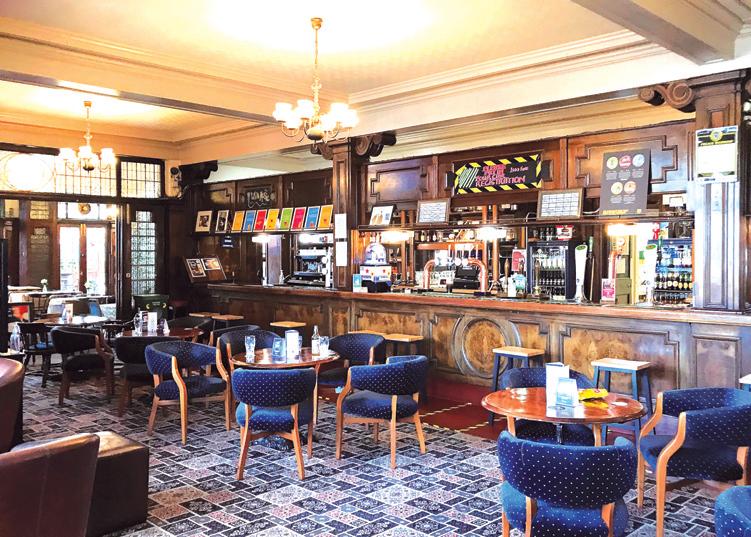
The Oak Bar is plainer and was the public bar to the Walnut’s saloon. Here the style is Brewers’ Tudor, with beams cased-in to imitate sturdy timbers and exposed joists, Tudor arches in the servery area and much wall panelling. The pub was last visited by the LPG in 2006 since when it has been smartened up, with an external repaint and the removal of banners and flags, both inside and out, which had advertised various satellite TV platforms. The building’s importance is recognised by a Grade II* listing and also by inclusion in CAMRA’s National Inventory of Historic Pub Interiors. The real ale offer at the time of the visit was restricted to Greene King IPA but many participants also took advantage of the pub’s hearty home-cooked meals. The Eastbrook name appears in a number of places locally and presumably references a long-culverted stream. The pub is a truly remarkable survivor which will always be worth the trek out to see it.
A short bus ride – or a long walk – took the group to the second pub, the Admiral Vernon at 141 Broad Street, Dagenham (RM10 9HP).
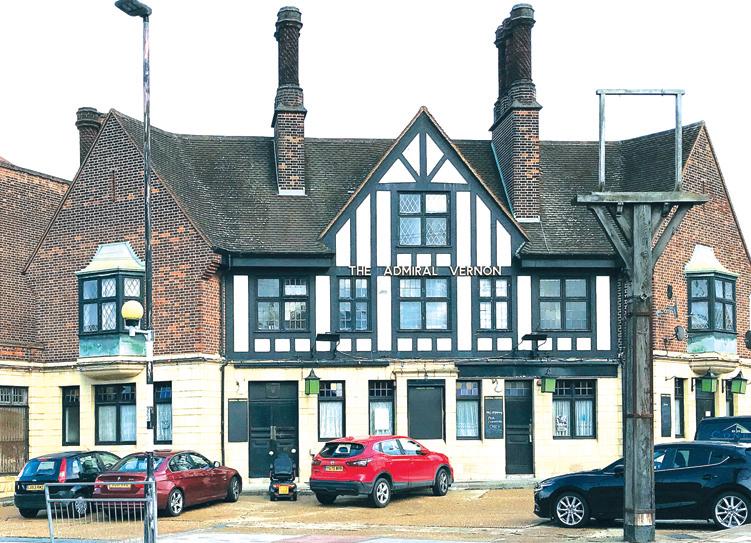
This pub is also on CAMRA’s National Inventory and is believed to have been built in 1937 for Courage to serve part of the vast London County Council Becontree Estate. Despite the intervening years, this estate pub has kept a great deal of its original plan, fittings and character. It is in the popular Brewers’ Tudor style with imitation exterior half-timbering above and buff faïence tile cladding below. On the far left is a former off-sales shop, now occupied by a floral designs business. The rear lounge bar/function room is in a single-storey part of the building. To the left is the public bar (originally two rooms) and the upper section of the partition that once separated them remains. It could be that what has been removed was a folding screen, as one survives in the right-hand bar. All the rooms have three-quarter height panelling and a decorative plaster frieze with depictions of hops, flowers and acanthus leaves. The original bar counters survive and there are orange terrazzo spittoon troughs around their base. The middle bar was also originally two rooms. On the left was a small snug and then a saloon bar and the upper part of the partition separating them remains. Behind the servery is the original publican’s office that is still in daily use. Folding doors separate the middle bar from the rear lounge bar/function room. Most parts are usually in the open position, with just the right-hand section being closed. However, for functions the folding doors are completely shut. The Gents’ here has access from both the rear and middle bars and retains its original doors, floor and wall tiling in both the ante rooms and in the toilet itself. The fixed seating throughout is modern. Although there has been more than one Admiral Vernon in British naval history, the pub is believed to take its name from Edward Vernon (1684 to 1757), who captured Porto Bello from Spain in 1739 during the War of Jenkins’ Ear. No real ale is available, despite several vestigial handpumps and only cash is accepted.
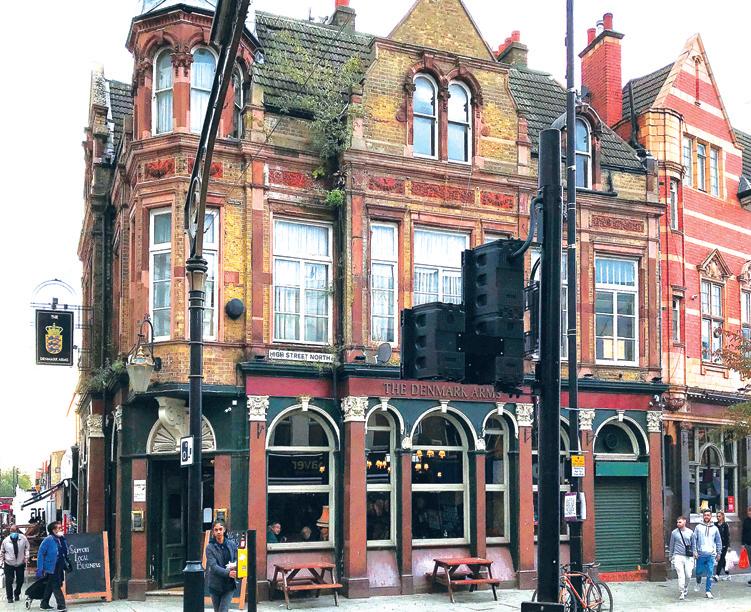
From here, it was back to Dagenham Heathway station for the District Line to East Ham for a bus or a walk to the Denmark Arms on the corner of Barking Road and High Street North (E6 1LA). This is a former Allied (Ind Coope Taylor Walker) pub now operated by the Antic Collective. The pub is Grade II listed and on CAMRA’s London Regional Inventory. There are two parts; a late 19th century building on the corner by Frederick Ashton and a major extension dated 1903 along High Street North. The ground
floor is now one large room wrapped around the servery. This is a more recent feature but sections of surviving floor tiling show where a larger and more substantial fitting once stood. What makes it special are the ornate details, notably the lovely tiled frieze on the back wall of the older part of the pub with its plain green tiles and statuesque rose bushes, reminiscent of the Glasgow School of Art. Above is a mottled alabaster band, then a decorative frieze with tendrils swirling round stylised rosettes. In the newer part (the former saloon) the treatment is different with a ceiling divided into bold panels with deep cornices and a high-level frieze with figures. The columns in the two areas are also different: thin Corinthian ones in the older area, chunky Ionic ones in the newer. On this occasion the upstairs function room was in use. The front part of this was once a restaurant whilst the back was almost certainly a billiard room and a very spectacular one at that, with a fine skylight. At the foot of the staircase is a unique feature for a pub; a ticket booth style shop for selling cigarettes and drink. This looks interwar, as do many of the features of the upper floor. The beer range on the day included Dragon Session Pale Ale from East London Brewing Co and Volden Session. There is no confirmed story as to the origin of the pub’s name but it was probably a tribute to Princess Alexandra of Denmark, who had married the future King Edward VII in 1863 and became Queen in 1901.
The final pub on the tour was the Boleyn Tavern at the junction of Barking Road and Green Street (E6 1PW). This is another Grade II-listed building and on CAMRA’s National Inventory. The Boleyn is one of the more spectacular late-Victorian pubs around and is a prominent landmark at a crossroads near the site of the former West Ham football ground. It is a thoroughly exuberant piece of French style Renaissance architecture built for the Cannon Brewery in 1899/1900 by Shoebridge & Rising, who were responsible for designing many fine pubs in London, including the Crown, Cricklewood; King William IV, Leyton; Red Lion, Whitehall; and Rising Sun (now the Rocket), Euston Road.
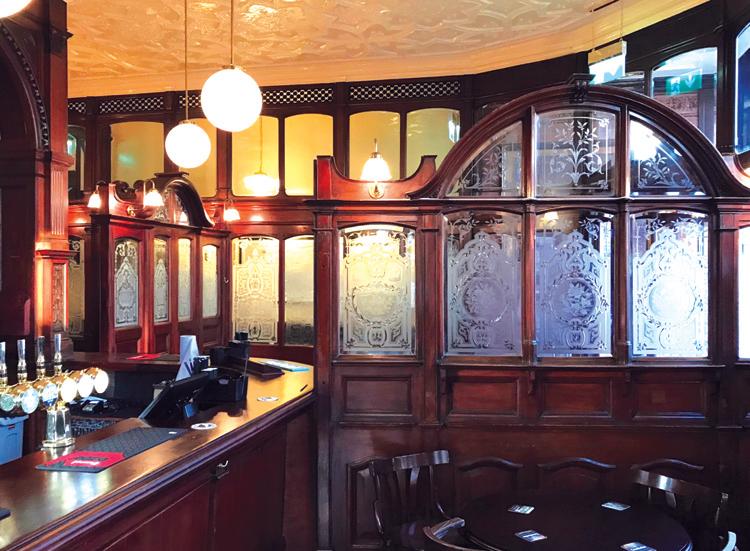
The exterior includes a corner turret and the Flemish gables so typical of the architects. In the latter days of the ‘Big Six’ breweries it had also formed part of the Allied (Ind Coope Taylor Walker) estate. For many years, the pub’s principal business was on West Ham home match days, and over time more and more internal divisions were removed to maximise serving and drinking space. The pub’s future looked uncertain after West Ham moved their ground to Stratford in 2016 and the pub closed. Salvation came in the form of its acquisition by Remarkable Pubs and it reopened in June 2021 after a spectacular £1.5 million restoration, intended to return the interior to how it looked c.1900 with a seven bar layout. This was achieved by installing new hand-crafted wooden screens, complete with acid-etched and Brilliant cut glass, replicating one of the original surviving wood and glass panels that had remained in the old saloon bar. A highlight is the spectacular glazed skylight that spans what once would have been a billiards room but is now an open kitchen, servery and dining area. This area has six dining booths available, each of which has a hand-painted mirror featuring a famous West Ham player from the past. The corridor to the lavatories is host to a display of photographs and memorabilia commemorating the football club. This pub was also visited by the LPG in 2006 when it found to be rather down at heel and so the transformation is little short of miraculous. The usual Remarkable Pubs beer range is available here, including Dark Star Hophead, East London Brewing Co Foundation, Fuller’s London Pride and Siren Session IPA. The pub obviously takes its name from Ann Boleyn (1507 to 1536), second wife of King Henry VIII, though her connection with the area is tenuous.
Kim Rennie (who also took the photos) and Jane Jephcote