The borough of Tower Hamlets has added 37 pubs to its Local List of buildings of ‘architectural, historical and townscape significance’. These pubs are those standing outside conservation areas. This measure is perhaps not as strong as an Asset of Community Value (ACV) listing although, following the general removal of permitted development rights in 2017, ACVs are not as crucial as they once were and a Local Listing still adds weight to appeals against development, the presumption being that the structure is worth keeping. In any event, to date, Tower Hamlets have only listed six pubs as ACVs. These include the Ferry House (E14) and the Widow’s Son (E3), both of which were nominated by CAMRA’s East London and City branch.
CAMRA’s national chairman, Nik Antona, commented, “It is fantastic to hear that Tower Hamlets has taken concrete steps to protect 37 historic pubs across the East End. Pubs play a hugely important role to our heritage, wellbeing and national economy, from stunning architectural designs that have stood the test of time, to street-corner locals that still offer a communal space for local people to meet and make friends. Using local listings is an innovative way to give pubs extra protection and sets an example that other local authorities may wish to follow. The pub and beer industry supports nearly 900,000 jobs across the UK and contributes £23.6bn to our economy – their importance simply cannot be overstated.”
This was echoed by a spokesman for the council who said, “Pubs have been the beating heart of communities in the East End for generations. They are local landmarks and valued additions to the landscape in our borough. Many of those that remain still have their original features intact: a charming nod to a bygone era. Sadly, across the country, we have seen more and more examples of traditional venues closing in recent years and it is right that, where we can, we take steps to protect these heritage assets. The pubs that are being put forward for local listing on this occasion are all located outside conservation areas. By using the local listing process, we are able to provide them with a degree of protection that they otherwise wouldn’t be afforded.”
This explains why certain pubs are not on the list. Tower Hamlets currently has 130 pubs (75 fewer than in 2001) so this is a substantial tranche but there are certainly others worthy of inclusion.
According to the Morning Advertiser, some pubs on the list were drinking haunts used by the Kray twins. Pub protection had a very different meaning in their day.
Back in 2014, the Black Lion in Bayswater, which dates back to 1704, changed hands for £27 and redevelopment seemed inevitable. Nothing then happened until 2016 when developers Fenton Whelan (FW) were granted planning permission by Westminster City council to demolish the pub and adjoining buildings and build a £450 million scheme for 55 flats in a nine-story block. The site was in the Queensway Conservation Area and some 1,500 objections were received, including ones from CAMRA, the Victorian Society and Historic England. Council officers advised that demolishing the existing buildings would have a harmful impact upon the architectural, historic and aesthetic characteristics of the conservation area. The grant of permission included so-called ‘planning gains’ under which FW would pay the council £8.5 million to help it fund affordable housing and a further £2.5 million towards improvements to public spaces. The project was then vetoed by the Mayor of London, then Boris Johnson. Sadly, the threat has now reappeared. The current mayor, Sadiq Khan, has reversed the decision following an offer from FW to increase the affordable housing payment to £11 million and contribute a further £4.8 million to the Community Infrastructure Levy, which pays for major projects such as Crossrail. Protestors, led by Alastair Lee, have petitioned Secretary of State, Robert Jenrick, to intervene and a spokesman said that if Mr Jenrick received an official call-in request, he would ‘give it consideration’. Mr Lee, an Australian, is amazed that buildings he admires are facing demolition. As he remarked, ‘They’re even older than my country’.
Renowned for its jazz, the Brewery Tap, Brentford closed under its existing management on 31 August. According to a statement issued by Fuller’s, the tenants decided to close down because of the loss of trade and disturbance caused by building works close by. Fuller’s hope to safeguard the pub’s future and will be consulting with the developers accordingly, but for the time being it remains closed. The pub is raised above street level – the wonderfully named Catherine Wheel Road – as a precaution against flooding from the River Brent. The brewery in question is the Grand Junction Brewery which was adjacent. This was taken over by William Gomm’s Beehive Brewery in 1877 and then acquired by Fuller’s in 1908. It was rebuilt in 1928 by C E Mallows in the ‘arts and crafts’ style. Let us hope that Fuller’s persevere with this special pub.
Sad news about the Earl Haig, Crouch End. Not surprisingly, Haringey Council’s planning committee have granted permission for this distinctive building to be converted to a children’s nursery. Curiously, the Council decided that rather than being classed as A4 (pub or other drinking establishment), its current use was ‘general community’ so the Local Plan policies protecting pubs did not apply.
There has been a pub on the site of the Old Pack Horse, Chiswick, since at least the 17th century. The current version, which features some splendid exterior tiling, was rebuilt in 1910 by one of our most illustrious pub architects, T H Nowell Parr. It is Grade II-listed and its interior is regarded by CAMRA as being of regional importance. As built and in the usual style of those days, the pub was split into a number of separate rooms. Mr Nowell Parr divided one side of the pub by using a distinctive Tudor-style archway. Sadly, the current owners, Fuller’s, decided to open up the pub by removing the arch and they replaced it with a somewhat inelegant metal beam, as can be seen in the photo. Note the archway behind the bar. For a listed building, these works required consent from the local planning authority; this was not obtained. The situation was brought to the attention of CAMRA’s London Pubs Group whose chairman Jane Jephcote (see below!) notified the London Borough of Hounslow accordingly. They served an enforcement notice requiring reinstatement. Fuller’s responded quickly and properly by commissioning a ‘heritage technical note’ which detailed the remedial works required. Hounslow council approved the plans and issued the necessary listed building consent in mid-August. The archway will be restored in materials matching the original in due course. I’m sure that Fuller’s, who own a number of listed and historic buildings, did not deliberately intend to flout the regulations here but I’m sure that they will be reviewing their internal procedures. Our heritage – and the law! – must be respected.
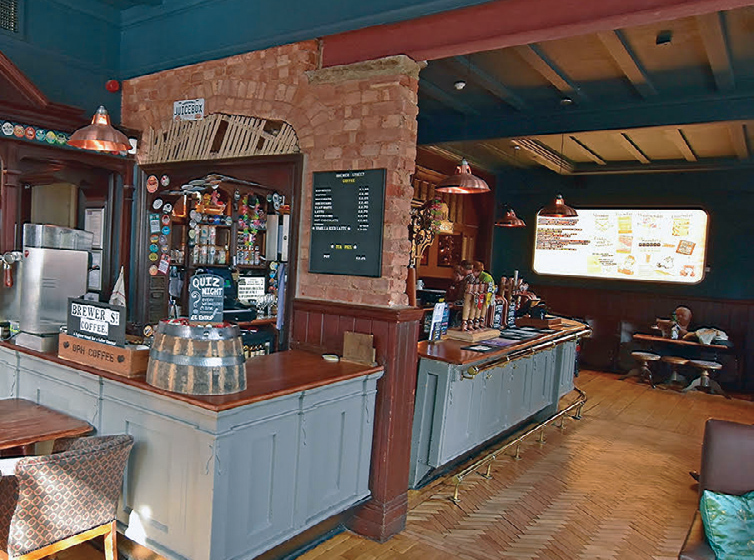
Good news, for now at least, about the Squirrel in Maida Hill. As reported in the last edition, the upper floors have already been converted into flats and owners the Cowell Group requested planning permission to do likewise to the remainder of the building by turning the ground floor and basement into five flats. Westminster City council have however refused the application. The pub is included on CAMRA’s Inventory of Pub Interiors of Outstanding Historic Interest so had the proposal gone through, that would have been lost. The Cowell Group have however indicated that they will appeal. The pub has been closed for the last ten months after lessees, Faucet Inn, went into administration. The Cowell Group have a portfolio of properties in Soho, Holborn and Pall Mall and director Adrian Levy was quoted in the MyLondon.news news site as saying that the firm had tried for two years to find a new tenant, but with no luck. He continued, “People talk about wanting to save the pub but the local community didn’t use it enough when it was open, so it wasn’t profitable. We have had the building for about nine years. We didn’t want the pub to close down. But if you’ve got an empty building, what do you do? Especially when London has a housing shortage.” Labour councillor Tim Roca, who is campaigning to save the pub, said, “We’re relieved the council has backed the community campaign to reject this application and save a much loved local pub. The area has lost so many to developers in recent years despite proof that, if well-run, they are viable, popular places where people come together. We want to work constructively with the owners to see it restored to the thriving local pub it used to be.” Westminster City cabinet member for planning, Richard Beddoe, added, “It’s vital we do all we can to save this sort of pub from the wrecking ball. Through our new city plan, we’re putting policy in place to preserve pubs and all the character they bring to our communities.”
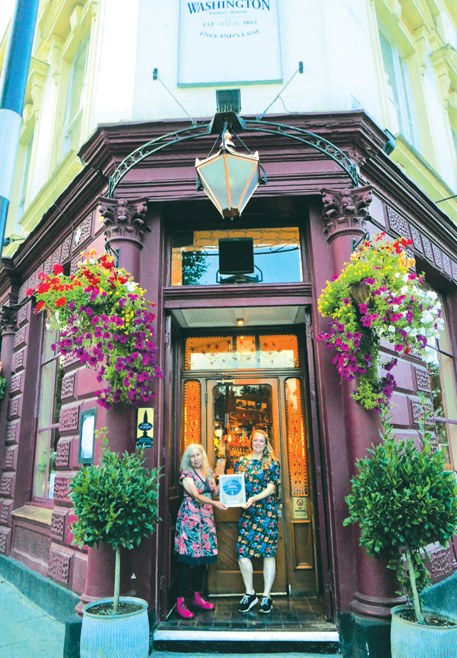
The Washington, an imposing Victorian corner pub in Belsize Park NW3, recently had a change of management. At this point it was realised that the plaque commemorating its place in CAMRA’s National Inventory of Historic Pub Interiors had disappeared. Jane Jephcote of CAMRA’s Heritage Pub Group worked with CAMRA’s North London branch to put the matter right and Jane was delighted to hand over a replacement plaque to Antonia Orpen, the ‘first lady’ of this lovely Grade II-listed building which has many surviving Victorian features, such as the Corinthian columns flanking the door, painted mirrors and mosaic floors. For more details visit WhatPub .
Christine Cryne
Readers will recall that the owners of the Grade II-listed White Hart, New Cross, the Wellington Pub Company, had applied for planning permission to convert the upper floors of the pub into flats, at the predictable expense of the pub’s business as a music venue. This was confirmed when the Environment Agency recommended that, were the conversion to take place, sound insulation would be required, opening hours restricted and live amplified music banned. Urged on by the publicans, brothers Patrick and Joseph Ryan, customers and local residents appealed against the application and Lewisham Council refused both planning permission for the flats and the necessary listed building consent. One objector, as quoted in the Morning Advertiser, said, “The management and staff working under Paddy have worked wonders in turning around a pub which was virtually always empty into a welcoming, vibrant venue which attracts people from diverse backgrounds who live locally or from further away. It has been a significant success story and it would be such a shame if it had to close.”
In our June/July edition I mentioned that the owner of the Winchester in Highgate was attempting ‘salami slicing’ tactics in trying to convert parts of the pub to residential use bit by bit. The subject of the latest scheme was the function room at the back of the pub. I’m pleased to say that Haringey Council have listened to the vociferous local objections and have refused planning permission. Alas, it is unlikely that this is the end of the matter.
Compiled by Tony Hedger, except where credited