At a time when many London pubs are quietly slipping out of use, it is encouraging to report on a campaign that is not satisfied with simply preventing loss but is actively working to secure a long-term future for a much-loved local. The Trafalgar, tucked away on High Path in South Wimbledon, has been trading in one form or another since the nineteenth century. In recent years, under the leadership of Oli Carter-Esdale, it has once again become a proper free house: independent, well-run and valued equally by long standing regulars and newer customers.
The problem for the Trafalgar lies in its location. Flush at the edge of a major regeneration area, its front doors look out onto newly built flats and astroturf, while its beer garden backs onto boarded-up homes awaiting demolition. This uneasy position has resulted in repeated proposals for its demolition and redevelopment, all of which have been refused in recognition of the pub’s cultural and social value. Last year, an appeal was dismissed by the Planning Inspectorate, confirming at a national level that the building and its continued use as a pub should remain.
Planning victories however only take a campaign so far. With the pub’s current lease approaching its end, the Trafalgar’s loyal customer base has recognised that avoiding demolition is not the same as securing the pub’s future. The result has been the formation of Save the Traf, a community-led campaign now exploring a practical and increasingly well-evidenced solution: community ownership.
No longer a novelty, there are now more than 200 community owned pubs across England operating successfully. Evidence gathered by CAMRA and organisations such as Power to Change suggest that once established, community pubs have strong survival rates, benefiting from local stewardship, loyalty and an approach that prioritises continuity over short-term returns. For the Save the Traf campaign, this model is particularly appealing. Far from being a failing business in need of rescue, it is a thriving, award-winning pub with an active and loyal customer base. What the campaign believes is that community ownership of the freehold will ultimately achieve is stability for Oli, his staff and customers after years of uncertainty. Momentum has built quickly. A public meeting held in March attracted over 100 residents, a clear indication of the depth of local support. Since then, volunteers have been working through the practicalities of governance, finance and engagement, while maintaining dialogue with the current freeholders.
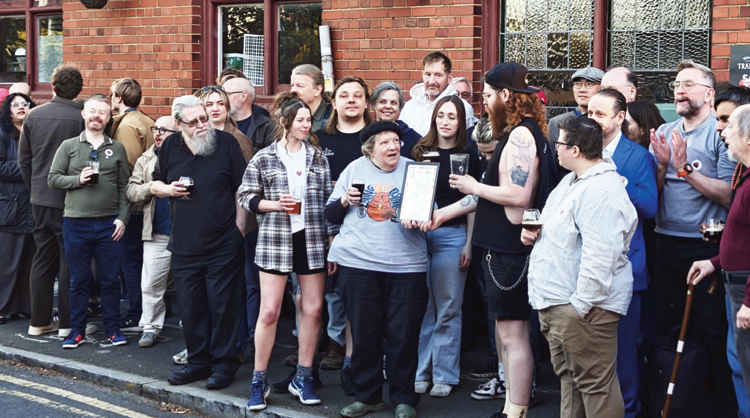
The campaign was given a timely boost when the Trafalgar was voted 2026 Pub of the Year by CAMRA’s South West London branch. The presentation was made on 24 April at the Trafalgar’s Spring Beer Festival. With punters spilling out onto the street, the festival was a reminder of exactly what is at stake: not an abstract planning principle but a living, working pub doing what pubs have always done best.
It is easy to talk about how, conceptually, to make a place better through ‘place-making’ and ‘improving the public realm’. It is harder, but more important, to recognise when a place already works. The Trafalgar does. Community ownership has emerged as the clear route forward, providing a realistic and proven means of securing it as a proper pub for this corner of South Wimbledon for generations to come.
For campaign updates, go to www.savethetraf.co.uk.
Rebecca Coleman
on behalf of the CBS committee