FLAT CONVERTED INTO PUB!
That’s a headline I never thought that I would write. Steve Silcock of CAMRA’s South East London branch informs me that the owners of the Dog & Bell in Deptford have acquired the lease of a ground floor flat in an adjoining building and have obtained planning permission to use it to extend the bar and drinking area. The flat was originally zoned for commercial use when the block was built and so this reverses the usual ‘Trojan horse’ process. South East London branch supported the application. Steve reports that, from the inside, the extension blends in seamlessly with the original pub and has increased the pub’s overall floor area by around a quarter. This follows a significant investment in outdoor canopies and seating made in recent years.
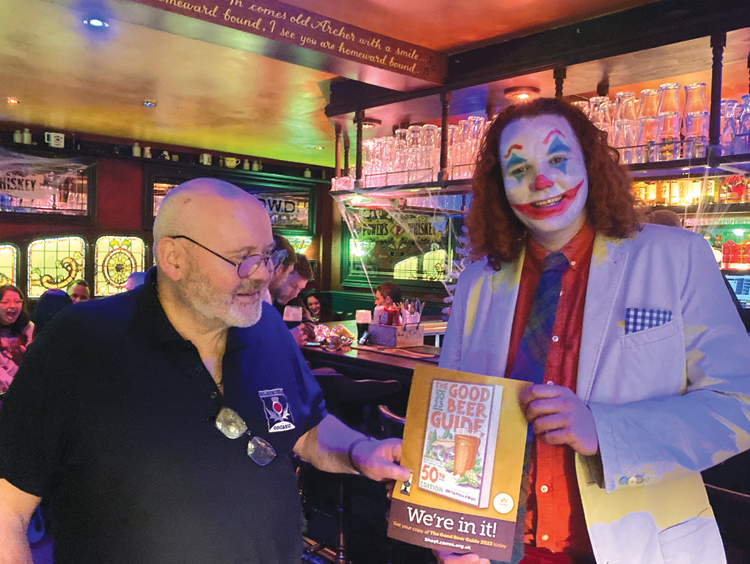
This local institution has also now secured its 36th consecutive entry in CAMRA’s Good Beer Guide. The photo shows branch social secretary Andrew Sewell presenting the pub’s GBG poster to the Joker, otherwise the pub’s tenant, Seamus O’Neill.
A CLARIFICATION
It was encouraging to see the Guardian newspaper (29 October) include a substantial article in their Saturday supplement giving case studies of some pub closures. One of the cases covered was the Junction in Loughborough Junction which I mentioned in the October/November edition. The article stated ‘Under planning laws, if the landlord of a property can prove that a pre-existing hospitality business is not viable there, then it can be converted into flats’. I feel that that statement requires some clarification.
As the law stands at present, a change of use from sui generis drinking establishment to any other purpose always requires planning permission. The viability of the existing business comes into question when the planning authority, usually the local authority, are assessing the application. These days, in Greater London at least, the presumption should be to retain the pub. Section 7.7.7 of the Greater London Authority’s Policy HC7 ‘Protecting public houses’ specifies that ‘To demonstrate authoritative marketing evidence that there is no realistic prospect of a building being used as a pub in the foreseeable future, boroughs should require proof that all reasonable measures have been taken to market the pub to other potential operators. The pub should have been marketed as a pub for at least 24 months at an agreed price following an independent valuation, and in a condition that allows the property to continue functioning as a pub. The business should have been offered for sale locally and London-wide in appropriate publications and through relevant specialised agents’. The developer’s agent will usually try to persuade the planning committee that they have done this but there were no takers. Exactly how they have gone about that task always warrants close examination.
To remind readers, the general aim of the GLA’s Policy HC7 is that in Development Plan documents, town centre strategies and planning decisions, boroughs should, ‘protect public houses where they have a heritage, economic, social or cultural value to local communities, or where they contribute to wider policy objectives for town centres, night-time economy areas, Cultural Quarters and Creative Enterprise Zones’.
KENSINGTON AND CHELSEA LOCAL PLAN
The Royal Borough of Kensington & Chelsea is currently consulting on an update of its Local Plan. This contains some very positive provisions regarding pubs. Section B of policy TC5 states that the Council will ‘Resist the loss of public houses and other drinking establishments throughout the Borough’ and section 5.62 says that ‘the Council will have regard to Policy HC7 of the London Plan, ‘Protecting public houses’, when considering any application which includes the loss of a public house or pub floorspace’. The additional specification of ‘floorspace’ is very significant. Section 5.63 goes on to specify, ‘Any proposal which includes the loss of upper floors or ancillary uses such as function rooms and staff accommodation must demonstrate that this loss will not compromise the operation or viability of the public house. Measures must be put in place which would mitigate the impacts of noise for new and subsequent residents is accordance with the ‘agents of change’ principle’. If any readers who are RBKC residents would like to support these measures, the consultation runs until 22 December. Go here to see the consultation documents and comment on-line. Alternatively, you can download a response form from the same site. The next stage is for the council to submit the plan to the Secretary of State for Levelling Up, Housing and Communities who then appoints an inspector to examine the plan. The inspector will take into account all comments made at this stage. If accepted, this could be a template for what we would like to see in all London borough local plans.
CONVERTING PUBS TO RESTAURANTS
This is an appropriate point at which to remind readers that converting a pub to a restaurant (with no bar and table service only) is a change of use (from sui generis drinking establishment to Class E (b)) which requires planning permission. This also applies to any attempt to convert a pub to a hotel (Class C1). This is important because it has implications for permitted development rights which may make it easier to eventually convert the property to residential use. The addition of a dedicated restaurant area to an existing pub is however permissible so long as the pub continues to function as a drinking establishment.
PLANNING REFORM
The Government have been making noises about reforming the planning system for some time. The minister responsible is the Secretary of State for Levelling Up, Housing and Communities, who is, once again, Michael Gove. A bill, the Levelling Up and Regeneration Bill, was introduced in May 2022 and is currently making its way through the House of Commons. My understanding is that its principal aim is to speed up and simplify planning procedures. This could involve removing some protections that could affect pubs, especially in new enterprise zones where the local authority may be replaced as the planning authority. These changes may be enacted using secondary legislation, so may not be immediately obvious from the terms of the Bill. The Local Government Association have commented that the Bill ‘is not easy to read or to understand’ and so more research is needed.