Carlsberg Britvic to cease brewing cask beer
At the beginning of October, Carlsberg Britvic (CB) announced that they were closing what was originally Marston, Thompson & Evershed’s Albion Brewery in Shobnall Road, Burton on Trent. The site, which dates from 1834, will close next summer with the possible loss of up to 300 jobs. This is the last remaining brewery in CB’s portfolio that has the capacity to brew cask beer. It currently brews the few Marston’s brands that remain, plus an assortment of beers acquired over the years from breweries that CB and its predecessors have taken over. These include Young’s.
CB say that the ‘stark reality is that UK cask ale volumes have more than halved in less than a decade’ and that they prefer to concentrate on their more popular products. Their chief executive did however have the decency to add, “Marston’s Brewery, its history and legacy in Burton upon Trent are iconic, and our teams there are true experts in ale. This proposal, therefore, is by no means a reflection on any of our people, and every effort will be made to help them through this period of uncertainty.”
Despite their saying that cask beer sales are falling, CB are still expected to contract out the brewing of at least some of the cask brands to independent breweries, which could be a boost for those involved. We will report on what arrangements CB make, although these contracts are often subject to non-disclosure agreements.
One particular brand that gives cause for concern is Draught Bass. The brand is owned by another global brewer, AB InBev, who have no facilities to brew it themselves and so, until now, have contracted its brewing to CB. Aficionados, of whom there are many, rate the current product as being as good as it has been for some time and AB InBev have recently started to put more effort into promoting the beer. Presumably it will be for AB InBev themselves to find a replacement brewer.
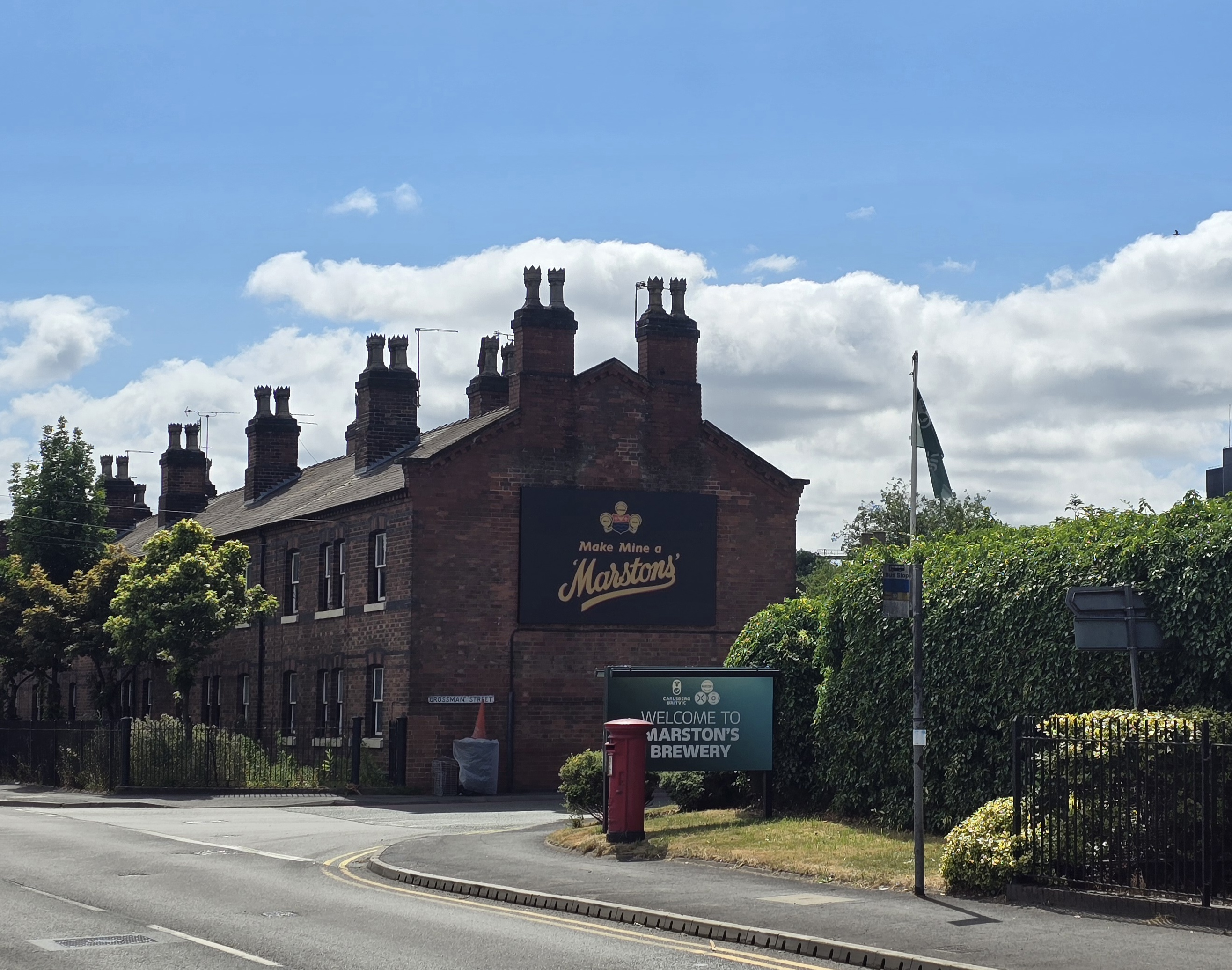
Some history, just for clarification. Marston’s pubs are operated by a separate company that no longer has any connection with Carlsberg Britvic, apart from what they call a ‘long-term brand distribution agreement’ for their beers. The original Marston’s brewery company was taken over by Wolverhampton & Dudley Breweries in 1999 and W&D adopted the name Marston’s for trading purposes a few years later. In 2020 Marston’s came to a deal with what was then Carlsberg UK to merge their brewing interests into the Carlsberg Marston’s Brewing Company (CMBC). Marston’s had a 40% stake in CMBC but sold out to Carlsberg in September 2024 for £206 million, giving CMBC full control of the breweries. This left Marston’s to concentrate on their estate of around 1,350 pubs, bars and hotels across England and Wales. They recently predicted that, for the year ended 26 September, their underlying profit before tax will be ‘above the top end of market expectations’.
Marston’s have also announced that they intend converting around 100 pubs to their ‘Grandstand’ format which, they say, will bring ‘the unrivalled atmosphere of a stadium match or event’ to the pub with three-metre-long TV screens, flexible tiered seating and ‘match-day ready’ food and drink menus, whatever that means. One of the first to be converted is the Deer’s Rest in Noak Hill near Romford. They have also put the freeholds of a dozen pubs in the midlands up for sale.
A long way to go…
Readers will recall that, earlier this year, Molson Coors (MC) announced that they were to close Sharp’s Brewery in Rock, Cornwall. MC have now confirmed that the closure will take place by the end of this year, with the potential loss of around 40 jobs. MC say that the site is ‘no longer financially sustainable’ despite having invested over £20 million there since they acquired it in 2011. MC are ‘exploring a potential sale of the premises’ although this may not necessarily be as a brewery.
If there was one practical consideration that supported this decision it was access, given that transport links to north Cornwall are not the easiest. It is therefore somewhat baffling that MC have set up a contract for cask Doom Bar to now be brewed at Camerons Brewery in Hartlepool, County Durham, well over 300 miles in the other direction. Camerons, whose best known beer is Strongarm, are experienced contract brewers and I hope that the business is good for them. They may even produce a better beer. Doom Bar has however recently lost its ranking as the country’s top selling cask beer to Taylor’s Landlord.
As many readers will know, the Doom Bar is a geographical feature; a sandbar in the estuary of the River Camel, near Padstow. MC’s marketing people have always promoted the brand’s Cornish connection but CAMRA’s Cornwall branch has made it clear that this should no longer happen. Happily, Private Eye (edition 1686) also picked up on the story, giving it useful publicity.
East London Brewing Co
In April, ELB, now in their 15th year, moved into the former Wild Card Brewery site on the Walthamstow Beer Mile. The move has enabled ELB to more than double their production. A pub, called the Black Horse Tap, has now been added to the site (E17 5RB) and is due to open on 27 November. The existing brewery tap is being retained.
Rebellion plan for the future
A problem that eventually faces many independent breweries is their continuation once their founders retire or are otherwise no longer around. The Rebellion Beer Company, based in Marlow, Buckinghamshire, has decided to transfer ownership of the company to an Employee Ownership Trust (EOT). The founders will continue to be involved until a new management team, comprised of existing long-term employees, is ready to take the reins. The arrangement will safeguard around 75 local jobs, as well as preserving the brewery’s community spirit and ethos.
Sheps to build new brewery
In recent years a number of breweries such as Thwaites, Hydes, Wadworth, Wells, Everards and Greene King have built new breweries on brownfield sites out of town, enabling them to modernise their brewing process and free up a potentially valuable city centre site. Shepherd Neame have announced that they are doing something similar, although with one difference: they are building their new brewery on their existing site in Faversham. It will replace the existing bottling hall and, crucially, it allows Sheps to continue using their historic artesian well. ‘Small packaging’ will be contracted out. The two-year project is expected to cost around £15 million and will, the company says, “secure the next generation of brewing in the town” and will, “provide us with the flexibility to continue to innovate and develop our portfolio in a rapidly evolving beer market“. In the meantime, brewing will continue as usual.
Sheps are following the pattern set by Greene King with the Old Speckled Hen brand (before they sold it) and Adnams with Ghost Ship in turning Bishop’s Finger into its own brand. The first new beer is Bishops Finger IPA Reserve (5.5% ABV), described as a ‘golden, vibrant IPA’. ‘Bishop’s Finger’ is the name given to a type of signpost on the Pilgrims’ Way, which pointed travellers towards the shrine of Thomas à Becket at Canterbury Cathedral.
New beer and pub for Allsopp’s
Allsopp’s are adding an IPA (4.4% ABV) to their beer range. The recipe was found in the only known surviving Allsopp’s brewing ledger, dating from 1822. The dark copper beer is brewed with English Golden Promise malted barley and Challenger hops. As with Allsopp’s other beers (Pale Ale, Best Bitter, Stout, Lager, Double Diamond and Arctic Ale) it is being brewed for them by the Kirkstall brewery in Leeds. It originally came about when Samuel Allsopp was commissioned by the East India Company to produce a beer that was strong enough in hops and alcohol to survive the sea journey to India. It is said that the beer was first brewed in a teapot!
Associated company Allsopp Taverns has acquired the grade-II listed Warrington Hotel in Maida Vale (W9 1EH). The pub will undergo a renovation that will see the addition of a separate restaurant on the first floor, along with ten hotel rooms. Their director, Charlie McVeigh, told the Propel newsletter, “Distinctive pubs act as showcases for the brewery and its heritage. We don’t want to do hundreds of pubs. We’d like to do a few pubs that are beautiful and we’re proud of, and make some money.” He added that the success of the Blue Stoops had given the group confidence to pursue larger projects.
Greene King new concepts
GK have a new concept called ‘Stay to Play’, featuring both traditional and digital pub games. They have spotted a demand for ‘competitive socialising’, which they believe will both attract and retain customers. Pool remains the biggest attraction, with the 600 tables across GK’s managed estate bringing in more than £2 million per annum, not including what the players spend on drink and food. Darts and shuffleboard come a long way behind but are growing. GK have 560 dartboards, 50 of them digital and more ‘digital darts lanes’ are being installed. Astonishingly, GK say that, in 2025, more than 13.7 million darts were thrown at boards in their pubs. If my experience is anything to go by, mostly at double one. There are 37 pubs with shuffleboards and GK recently installed its first electronic version, with more to follow.
In another innovation, GK have appointed their first female chief executive. Clair Preston-Beer, currently their chief digital and commercial officer, will take over next March in a planned succession.