On 15 April, CAMRA’s London Pubs Group visited the Smithfield area for an evening tour. The first visit was to the Viaduct Tavern in Newgate Street. This pub is Grade II listed and rates three stars on CAMRA’s National Inventory of interiors of outstanding national historic importance (hereafter ‘the inventory’). This popular Fuller’s pub (previously Allied, Ind Coope and Nicholson’s) was built in 1874 but the wonderful fittings seen today are from a remodelling by Arthur Dixon in 1898-1900. The separate drinking areas (as indicated by the multiple outside doors)
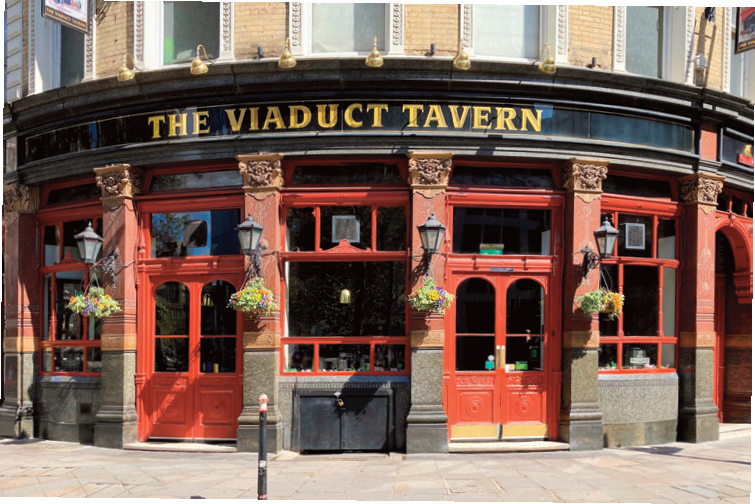
have gone but there is an amazing amount of excellent decoration. The etched, gilded and cut-glass panels at the rear are truly spectacular and are the equal of the work at the Princess Louise in Holborn. Another highlight is the small, glazed-in office at the rear of the serving area that was used by the pub’s management. The ceiling, with its swirling relief panels and which probably dates from the original build in 1874, is also a fine sight. Then there are the three paintings of languid ladies, signed ‘Hal’, on the right-hand wall representing agriculture, commerce, industry and art. The real ale choice was Dark Star Hophead plus Fuller’s ESB and London Pride.
Our second pub was the Hand & Shears in Cloth Fair, also Grade II listed and with three stars on the inventory. Popular with office workers at lunchtime and early evening, this is one of the best kept secrets among City pubs and looks the same as hundreds, if not thousands, of plainly-furnished London pubs did a century ago. The building probably dates from 1830 with later fittings. The corner entrance has an unusual pair of curved
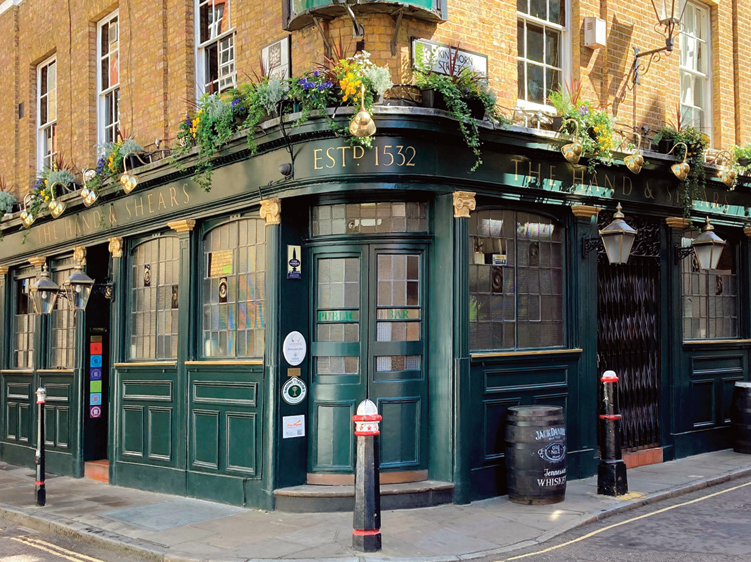
doors. There are in fact several doorways, each leading into a separate drinking space around the central servery. These areas are named in the door glass which looks like a refitting by Courage in the 1930s, viz: ‘Private Bar’, ‘Public Bar’ and ‘Saloon Bar’. Real ales on offer were Draught Bass and Timothy Taylor’s Boltmaker and Landlord.
The third stop was the Fox & Anchor in Charterhouse Street, another Grade II-listed building but with only one star on the inventory. The decorative gable at the top of the building dates this pub to 1898. There is a gorgeous Art Nouveau ceramic frontage and entrance. Designed by Latham Augustus Withall and built by W H
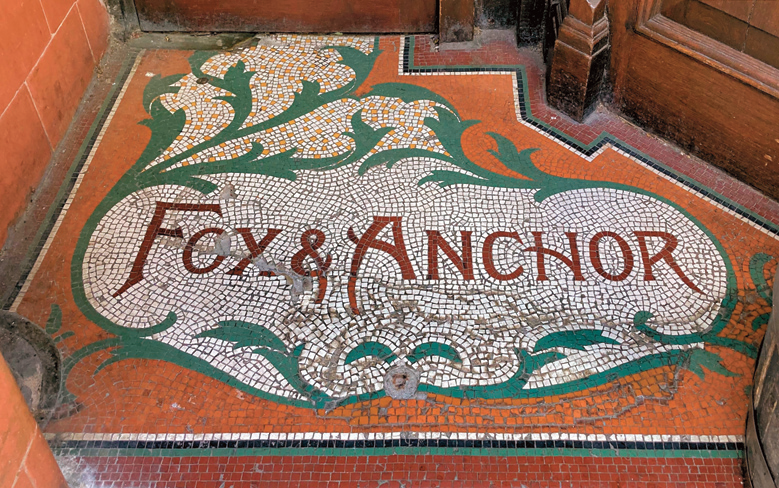
Lascelles and Co, the decorative panels on the inside external walls of the ground floor and the decorative front were designed by W J Neatby and manufactured by Doulton & Co of Lambeth. Inside, there is a long servery on the left with a pewter-topped counter. What looks like an original bar-back stretches along most of the wall behind the servery and has carved wooden pillars and bevelled mirrors. At the back, behind the main room, is a small panelled room with three tiny intimate snugs leading off it, though much of the woodwork here is thought to be relatively modern and may date from 1993. Formerly an Allied Taylor Walker house, it is now owned by Young’s and was serving Adnams Ghost Ship, Fuller’s London Pride, and Timothy Taylor’s Landlord on the night.
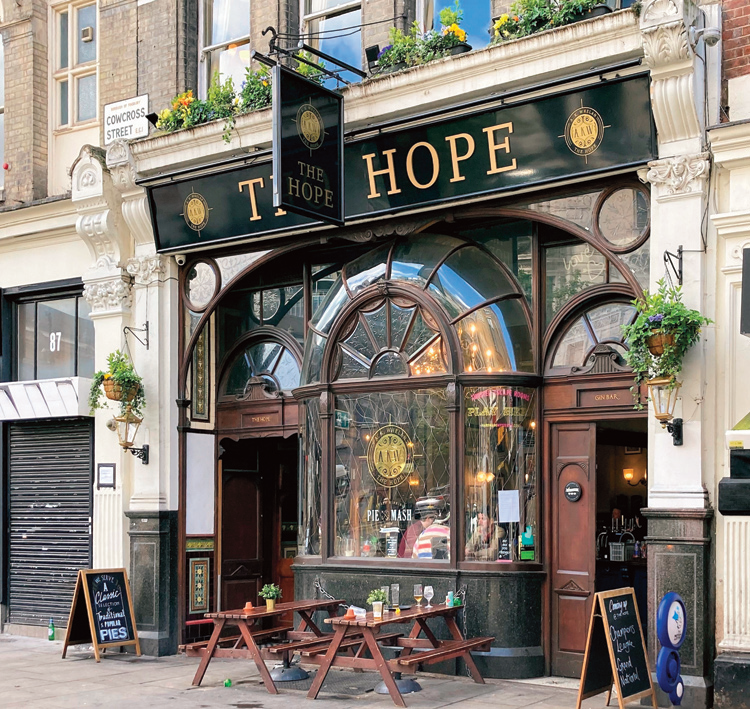
The next call was at the Hope in Cowcross Street. This Young’s house, previously Watney, is Grade II listed and rates one star pub on the inventory. The most striking feature is the left-hand wall with its beautifully coloured tiled dado. Above it there are three panels of decorative mirrors carrying painted intertwined monograms ‘TH’ (presumably ‘The Hope’). This is a late 19th-century four-storey building with many fittings from Victorian and inter-war times. Above a black polished granite base is a fine recessed pub frontage including a rare central bay bowed and curved window. There is a tiled dado in both exterior porches and tiled panels higher up the wall, but sadly the ‘Public’ and ‘Bar’ panels on the double doors on the right and ‘Smoke Room’ panels were replaced by plain glass during a refurbishment in 2017. The colourful tiled dado continues down the left-hand internal wall and the mosaic floor here confirms that there was a partitioned passage for access to the rear room prior to the removal of all room divisions. The bar counter dates from the late 19th century but the bar-back fitting was replaced in 2017. Fuller’s London Pride and Timothy Taylor’s Landlord are normally served here.
Ye Olde Mitre in Ely Court was our fourth venue. Finding this vibrant, historic pub in a tiny alley between Hatton Garden and Ely Place is a test of pub-going initiative but success is rewarded by several regular ales plus a guest. It is said to have been founded in 1546 to minister to the servants of the Bishop of Ely whose London residence was in the vicinity and whose headgear provides the name of the pub. This connection supposedly led to Ely
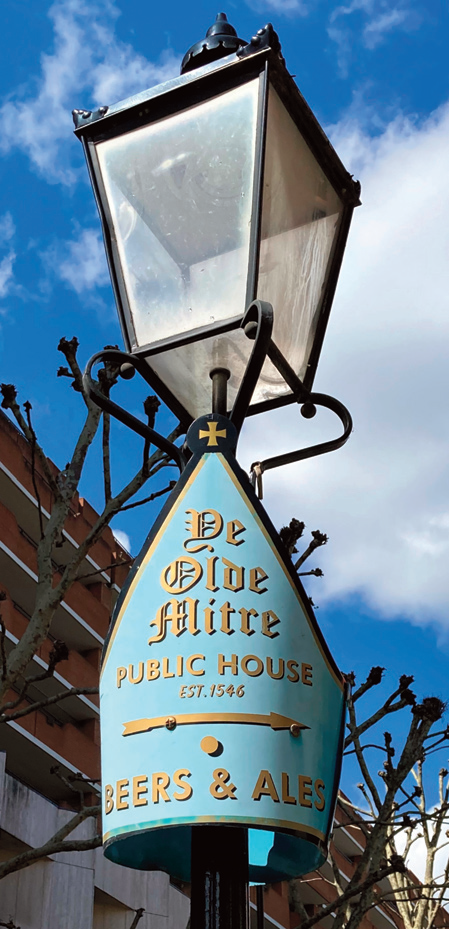
Place being legally in the county of Cambridgeshire until 1772. The pub was rebuilt at the end of the 18th century but the interior we see today is a remodelling dating from around 1930 with lots of panelling in the then-fashionable Tudor style. There are two rooms either side of a central servery: a small, cosy one at the front and a larger one at the back. Off the latter is an intimate little snug, now named ‘Ye Closet’. The upstairs Bishop’s Room was fitted out about 1990. The gents can only be entered from outside – a real rarity now in a London pub. Another Grade II-listed building, and with three stars on the inventory, this pub was once part of the Allied Friary Meux estate but is now owned by Fuller’s, serving London Pride plus the guests.
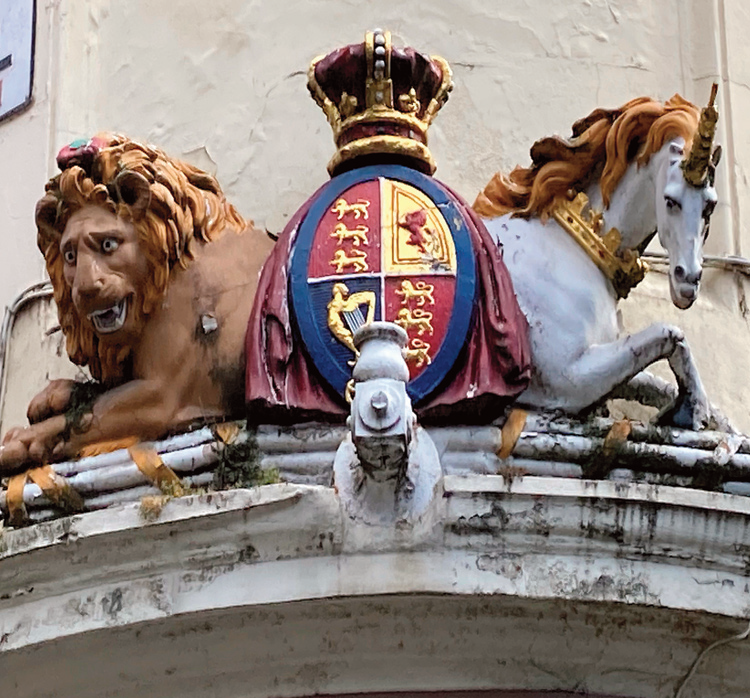
The evening concluded in the Craft Beer Co (formerly the Clock House) in Leather Lane. Yet again listed Grade II and scoring one star on the inventory, it has features from the 19th and early 20th centuries. This is a mid-19th century three-storey pub with a green glazed tile ground floor and rendered upper storeys. Three doors indicate that it was subdivided but is now a single room. It has a stunning ceiling of 19th century sectioned ribs and decorated ventilation grills, with mirrors added in the late 20th century. The bar counter dates from the early 20th century but has modern panels added to the front and a new bar top over the original one. The bar-back dates from the late 19th century and has five narrow mirrored strips with ornate capitals at the top. Notable is the free-standing royal coat of arms in stone above the corner entrance. Kent Pale (house ale) plus five changing cask beers are normally served here.
As an aside, something apparent on this tour was the extensive penetration of both Fuller’s and Young’s into a part of the capital far from their historic west and south-west London bases.
Jane Jephcote and Kim Rennie