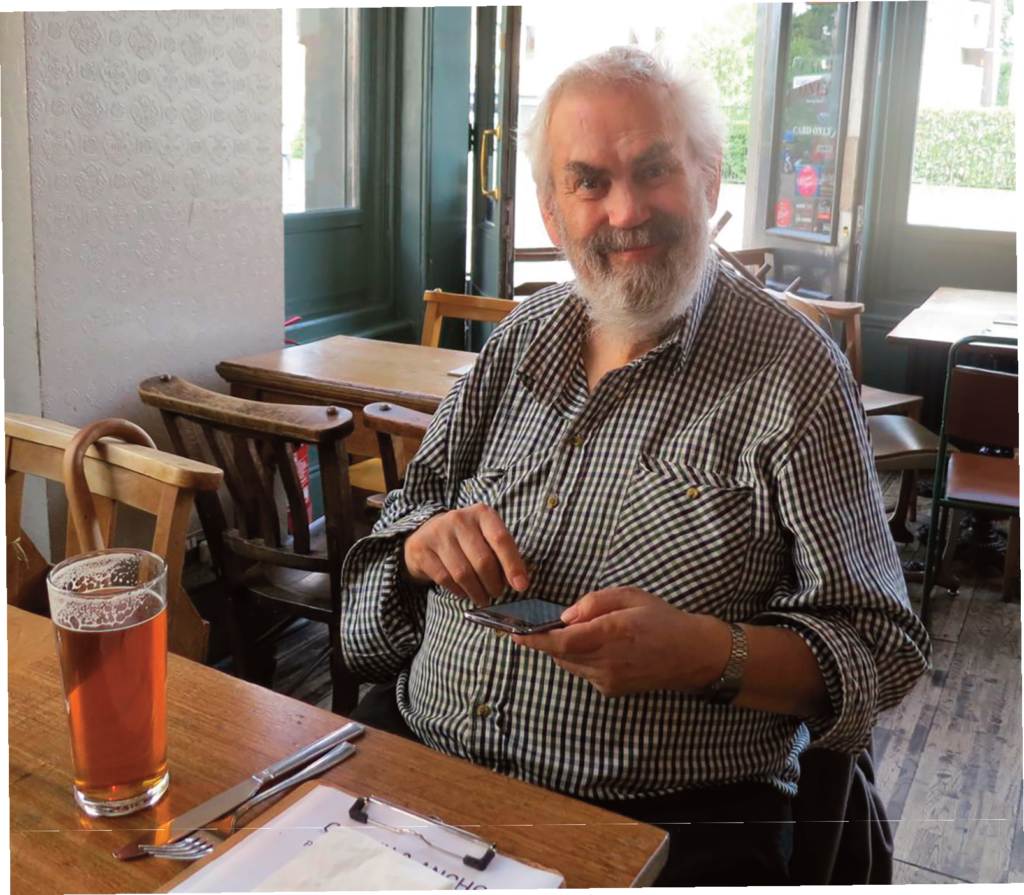
I am sad to report the passing of Chris Cobbold, on 26 June, after a long period of illness. Chris was prominent in the activities of CAMRA in London from the 1970s to the 2010s.
Chris was born in Worthing, Sussex, into a family who appreciated beer. His parents had been members of the Ancient Order of Froth Blowers. He came to London to train as a primary school teacher at the Froebel College in Roehampton (now part of Roehampton University). Chris was in the first cohort of male students that they admitted. After graduating, Chris took a post at Henry Cavendish Primary School in Balham where he spent his whole career. In the course of his 37 years there, he found himself teaching the children – and even grandchildren – of his original pupils. He was well respected and very much part of the local community.
Although he remained forever loyal to Sussex beers, Harvey’s Old Ale in particular, once in South West London he discovered Young’s beers. He joined CAMRA soon after, becoming active in South West London branch. He became chairman in the mid-1980s and held the post for 19 years. Chris’s management style was very much influenced by his profession and feathers were ruffled from time to time. Chris could be dogmatic and stubborn but the branch prospered.
SWL branch had previously run three one-off beer festivals but, in 1986, Chris proposed that it was time for another. Premises were identified (the William Morris Club at the ‘quiet’ end of Wimbledon Broadway) and the first of three Wimbledon Beer Festivals was held in February 1987 with Chris as organiser. It stocked only beers brewed by independent London brewers. I was recruited by a colleague to work at the second one and it was here that I first met the imposingly tall, broad and bearded Mr Cobbold. The success of the Wimbledon festivals led to larger premises being sought and, in February 1990, we held the first of 24 Battersea Beer Festivals in the impressive surroundings of the Battersea Grand Hall, behind the Arts Centre on Lavender Hill. Chris continued as organiser for the first few years and thereafter remained ever-present, meeting and greeting. A number of branch members, myself included, worked at all 24 events. Chris was always proud of his record of only ever having to throw out a customer on two occasions; both times it was his elder brother Bill… The hall was not available in 2015 because of refurbishment works during which a fire broke out. The hall was very seriously damaged and by the time it was available to hire again, we could not have incurred the increased cost.
By 1978, CAMRA’s London Region had grown to 13 branches and it was decided to launch a magazine to represent them all. That magazine was, of course, London Drinker. The first edition came out in March 1979. Chris joined the editorial team in April 1983, staying until the end of 1999. His co-editors, at various times, were Ian Amy, Dave Oram and Andy Pirson, who happily is still contributing. All editions of LD are available on our website and Chris’s writings are well worth reading. Chris took a rather laissez-faire approach to editing and a number of rather strange articles appeared during his reign. He continued also to distribute LD for as long as his health permitted.
Chris was a bar manager at the Great British Beer Festival for a number of years, along with fellow branch members ‘Uncle’ Ted Higgins and John Barry, both sadly no longer with us. John was the premises officer at Chris’s school and they had become very good friends. At Leeds in 1988 Chris met John Gilbert, a brewer for Watneys. John lived in South Wimbledon and so he was recruited into SWL branch. In due course, John moved to Salisbury to set up the Hop Back Brewery and Chris was an early supporter and shareholder, along with other branch members. When Hop Back began to open their own pubs, John promised Chris that there would be one in South Wimbledon and that it would be their only pub in London. The Sultan opened in 1994 and it became a second home for Chris on Saturday afternoons in particular, along with many others, me included. Chris later returned to the GBBF to work in the Finance Team.
Football was another of Chris’s enthusiasms. He ran the Wandsworth Schools Under 11 team for many years, with several of his boys going on to have professional careers. He was also a season ticket holder at Brighton & Hove Albion, regularly taking the train to Falmer until his health problems set in. On a Saturday, Chris always needed to know the football results as soon as possible and so, in the days before smartphones, I had to take my pocket radio to the Sultan and write them down for him. Usually, at five-to-six, a newspaper, open at the football fixtures, would be hurled across the table in my direction.
When visiting his friend Willie in Glasgow, they would often go to obscure games and Chris acquired a deep knowledge of lower league Scottish football and, in particular, whose brand of pies were available at the various grounds and their quality. I remember him telling me about one ground where he bought a pie at half-time but, as he was about to take a bite, a local told him that the pies were not for eating but for throwing at the players.
Travel, in various forms, played a large part in Chris’s life. He didn’t drive. In his early days he owned a tandem and made regular tours around the country, usually with his current lady companion on the back seat. In later years he made regular trips in Whitsun week with a group of teaching colleagues. Chris also usually managed to squeeze in a canal boat trip every year with an assortment of friends over the years.
Another annual event was the trip to Eastern Europe, nearly always Czechoslovakia, as it was when they started. The itineraries revolved around brewery towns such as Plzeň (Pilsen) and Brno rather than tourist centres. Quite often, German beer centres such as Dusseldorf were visited on the way out or back.
Chris was a railway enthusiast and regularly went on the steam-hauled ‘Great Britain’ trips that covered the length and breadth of the country. Once he went as far as New Zealand for a steam loco trip, making new friends in the process. One of those friends, Tim Cooper, recalls an incident one Sunday lunchtime in Kingussie, Scotland, when a tour was taking a break. Chris naturally made his way to the local pub and a number of people from the trip joined him. Without hesitation Chris bought them all a drink. The landlord was grateful for an unexpectedly busy but very worthwhile hour or so.
Chris’s interest in railway heritage saw him make substantial donations to various engine restoration and ‘new build’ projects. One in particular, on the Severn Valley Railway, was the building of a Riddles BR 3MT 2‑6‑2 tank engine. Locomotives of this type had once been common at Clapham Junction in Chris’s trainspotting days but none survived the end of steam services. When complete, locomotive 82045 will run on the Severn Valley Railway and will be a permanent memorial.
One of the best aspects of being a member of CAMRA is the opportunity that it provides to meet people with whom you would never otherwise have crossed paths. I am glad to have met Chris and to have had him as a friend. Chris is survived by his sister, Anne, and several nephews to whom we send our condolences.
Tony Hedger