On Saturday 21 February the London Pubs Group visited six pubs in the Kingston and New Malden areas. First was the Duke of Buckingham in Villiers Road. This pub rates one star pub on CAMRA’s National Inventory of pub interiors of special national historic interest. A suburban, red-brick pub built in the 1930s by Hodgsons’ Kingston Brewery (later taken over by Courage), as evidenced by the shield over the corner entrance bearing three salmons from the borough arms and a rebus with K and a tun.
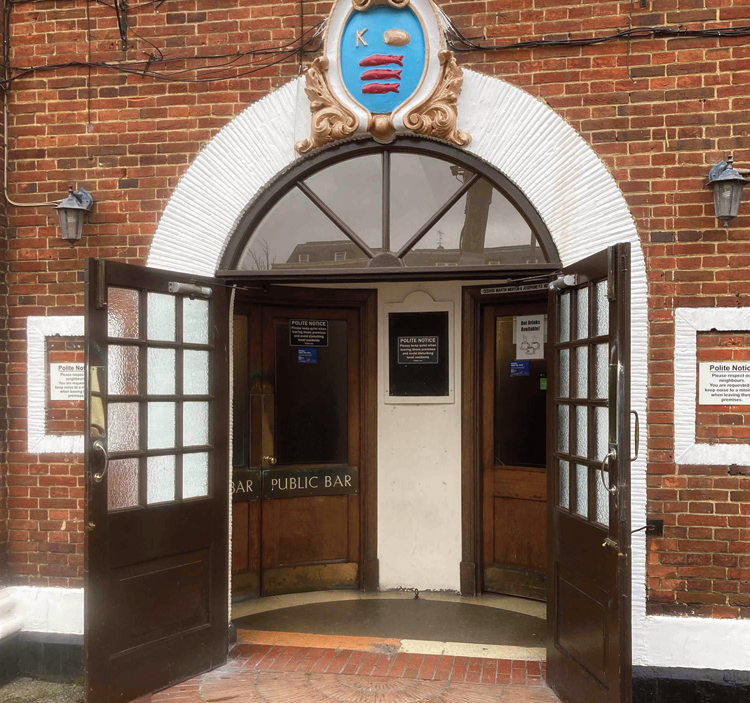
As you enter you can’t miss the attractive and most unusual curved doors: left to the public bar and right to a large room that is now an amalgamation of two original ones. Perhaps the most notable feature is the octagonal leaded skylight over the servery. There is also some original work in the fireplace, panelling, counters, parts of the stillion in the centre of the servery and curved cornices to the ceilings. Wainwright Amber is usually served here.
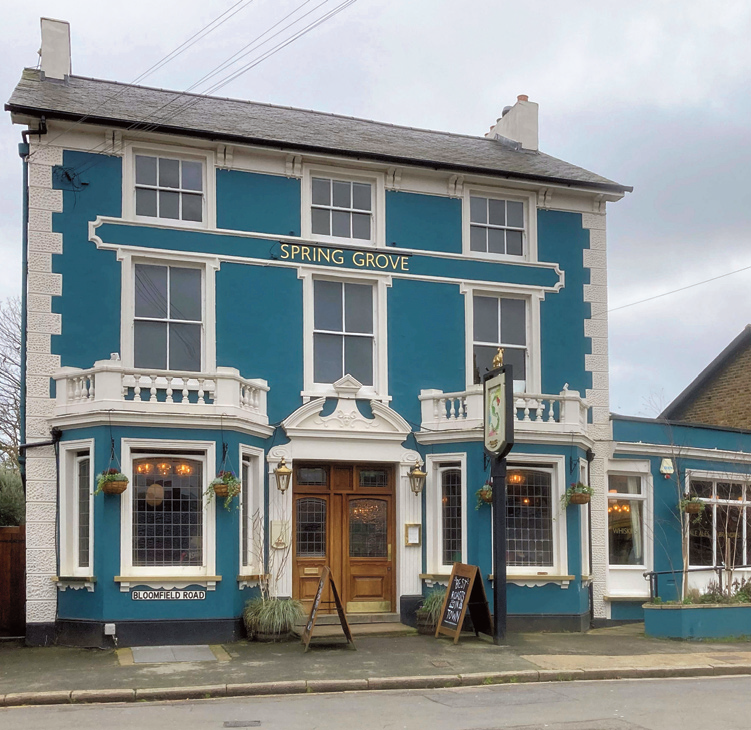
The second stop was at the Spring Grove in Bloomfield Road, an attractive building from 1867, retaining stained-glass windows (possibly inter-war). It was acquired by Young’s in 1922. Although opened-up, the pub still retains distinct areas, including a room labelled ‘Tap Room’ with a stained-glass skylight. The original 1892 plan of the pub can be seen at the entrance to this area. Inside the Tap Room there is a photograph of the exterior showing 1980s Young’s livery. The rear of the pub appears to be a modern extension that gives access to an attractive modern garden. A trip to the toilets affords glimpses of old photographs including one of sheep in Kingston town centre, a portrait of the young Terence Conran and a painting of Wolverhampton trolleybuses! Young’s London Original and Special, plus two changing guest ales such as Timothy Taylor Landlord or beers from Dorking Brewery and Twickenham Fine Ales are usually served here.
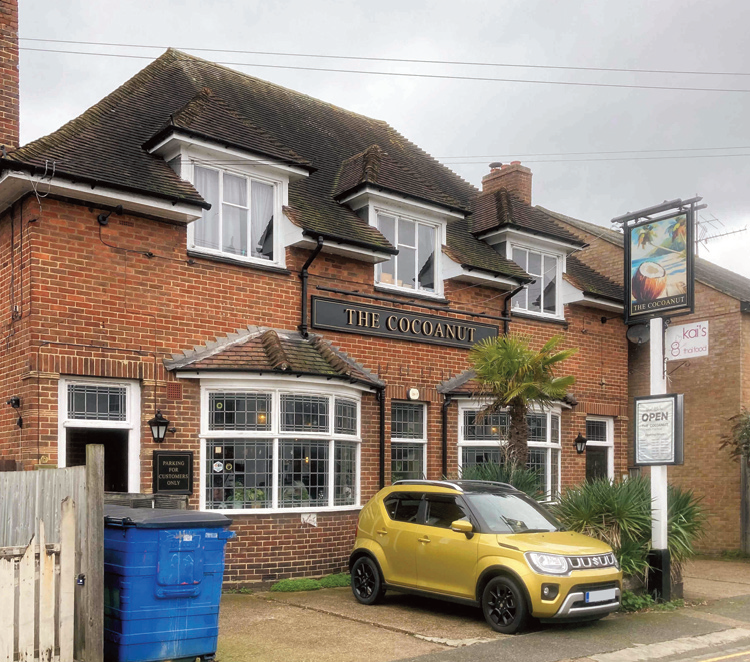
After passing the former Swan pub, closed in 2008 but still displaying its red and gold Courage sign, the tour reached the Cocoanut in Mill Street, another one-star pub on CAMRA’s National Inventory. There has been a pub on this site since at least the nineteenth century but the current building dates from the early 1950s. Plans to demolish the original building and construct a new pub were approved in July 1939 but interrupted by World War II. Charrington’s Brewery had started rebuilding in the spring of 1940 but had to stop in August because of a shortage of steel. Work was eventually completed by 1954: a two-storey building constructed of brick with a tile roof and two bow-fronted windows on the ground floor. These have their original green and clear leaded window panes, with the left-hand door having colourful leaded symbols, including a coconut. There are separate entrance lobbies on either side of the building plus a third entrance in the centre of the façade that leads to the original off-sales area. In the centre of the pub is a single U-shaped bar, with 1950s panelling in pale wood, although the bar was shortened and new glass panelling installed at the rear after 1987. The back-of-bar shelving may also date from the 1950s and has the wording ‘Wines’, a blank space that possibly originally said ‘Charrington’s’ and ‘Spirits’ along the top on both sides. The pub now consists of a single drinking and dining area, although when constructed there were three distinct rooms: a saloon bar, a public bar, and a games room, plus an off-sales area. The public and saloon bars were knocked into a single space in the late 1980s. Unfortunately, real ale is no longer served here.
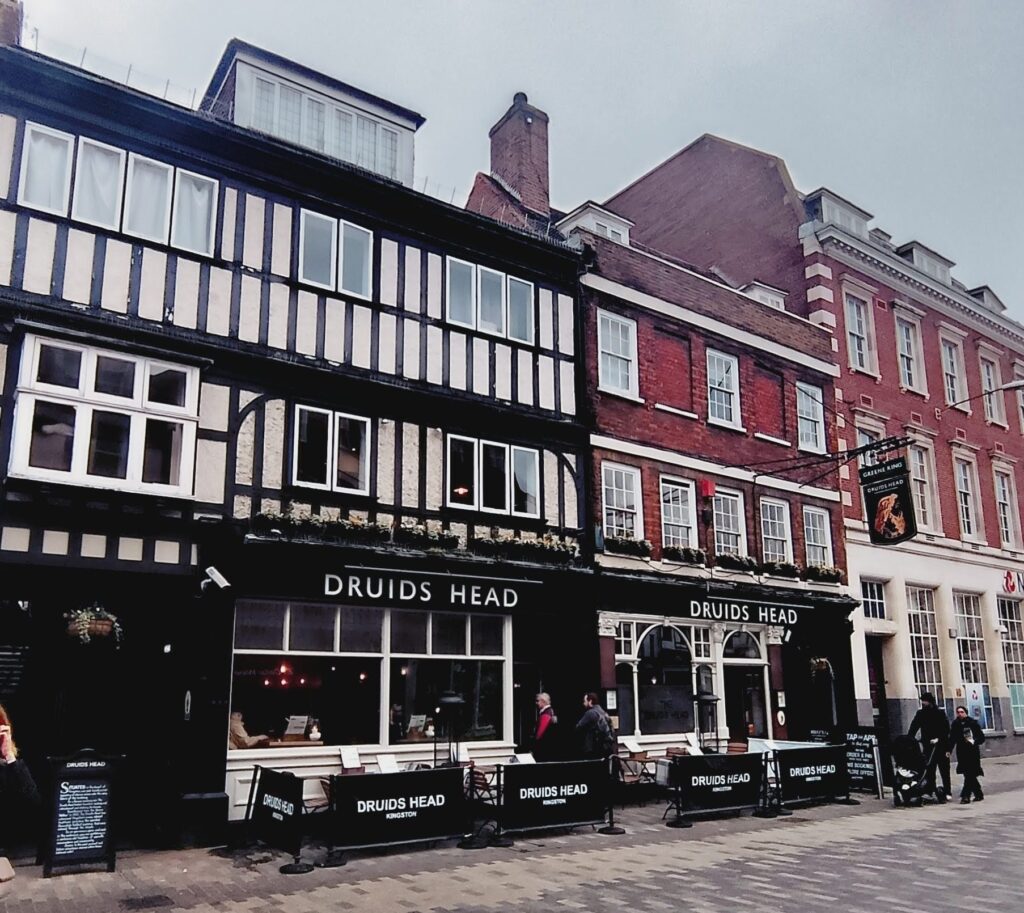
Next came the Druids Head, an ex-Whitbread pub in Market Place. This Grade II*-listed building is the last remaining pub in the market place area. It has some good surviving early eighteenth-century features, including a turned baluster open-well staircase, heavily moulded plaster ceilings and first-floor front room timber panelling. Greene King IPA, Abbot and Druid’s Head (house beer, probably Greene King), Timothy Taylor Landlord and two changing guest ales are usually served here.
The fifth pub was the Park Tavern in New Road. Another former Charrington house, originally converted from two cottages, it is on CAMRA’s Local Inventory of interiors of local historic interest. A plan dated 1927 shows a public bar on the front left, a saloon bar on the front right and a bottle and jug department between them. In addition, there was a tap room on the rear left (served by a hatch, which remains) and a bar parlour behind the servery, rear centre. The plan details a reduction in the extent of the bar counter on the right and confirms it has been in its present position since 1927.
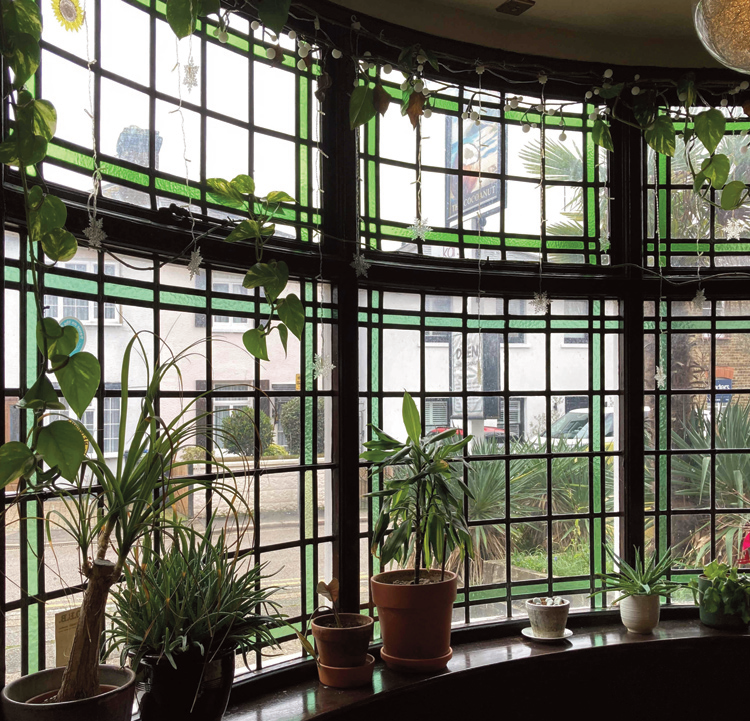
The counter is of an inter-war style. The mirrored bar-back looks old but the lower section on the left is modern. The front bay windows have inter-war glass. This pub is in CAMRA’s Good Beer Guide 2026 and was Kingston & Leatherhead CAMRA Branch’s 2025 pub of the year. Fuller’s London Pride and Youngs London Original plus four changing guest ales are usually available. The ceiling is decorated with pump clips, over 5000 in all, from beers that have been served here.
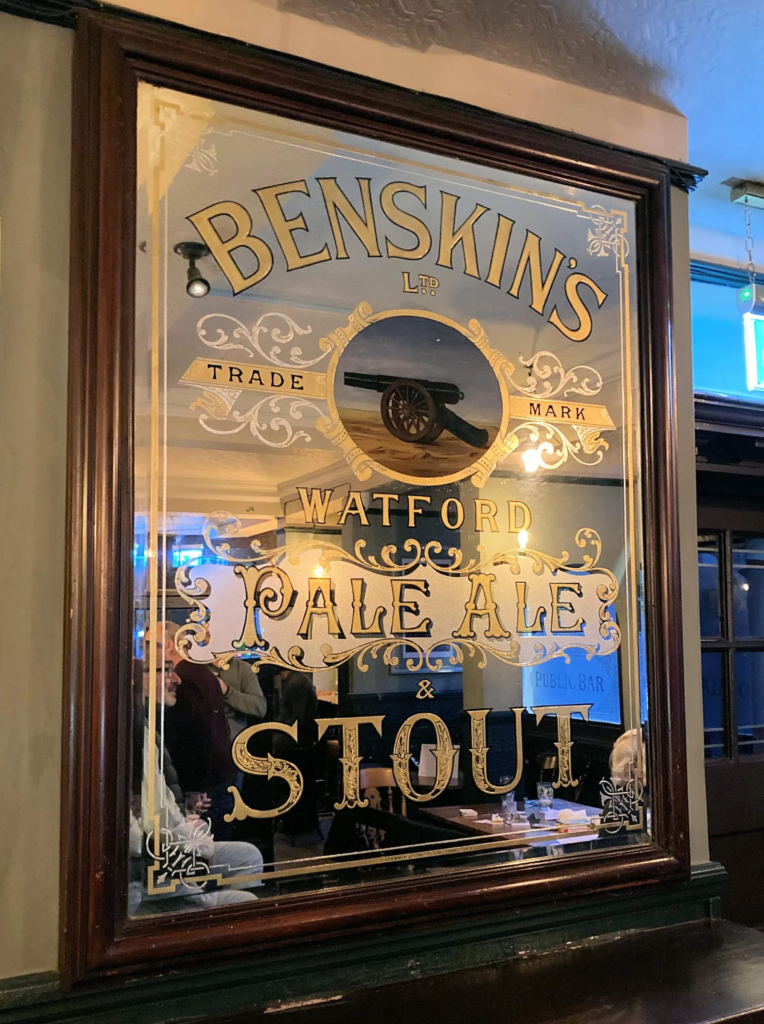
The final venue was the Royal Oak, Coombe Road, New Malden. This pub is Grade II-listed and is recognised by CAMRA as having a historic interior of local interest. It dates from the late-1880s or mid-1890s, with minor additions and alterations c1900 and later C20. Located on a corner site at the junction with Sycamore Grove, it was built to an asymmetrical plan of two, two and a half and three storeys, with a red brick ground floor and dressings, stock brick returns, rendered upper storeys, applied timber dressings and tile roofs. The public bar was to the left via a corner entrance, while the former hotel accommodation was accessed to the right. The public bar is subdivided by a panelled partition with a small door and there is a large horseshoe-shaped bar. Elsewhere a certain amount of coloured glass remains. A gilded and brilliant-cut mirror lettered ‘Benskins’ indicates its former owners, later part of the Allied Breweries estate. Adnams’ Southwold Bitter, Hogs Back TEA, Park Brewery Saw Pit and Wimbledon Copper Leaf are usually served here.
The Hogsmill of the title is a local chalk stream that rises in Ewell and flows into the Thames at Kingston. Near Kingston town centre it is crossed by the 12th century Clattern Bridge, believed to be one of the oldest road bridges in England.
This was a repeat of a tour that we originally staged in February 2020. That event was dedicated to the memory of Terry Casey, who for many years compiled maps for the Group’s crawls. This year’s event celebrated the memory of the Clive Taylor, London Pubs Group stalwart and a former resident of New Malden.
Jane Jephcote and Kim Rennie