If you walk around Kentish Town today, you’ll find a sizeable number of pubs, yet, over twenty-five years ago, there were even more, primarily based around the side streets. Since closure, many of these sites have been converted into residential and commercial uses, yet amazingly the buildings of around fifteen former pubs remain largely intact, offering a reminder into the area’s illustrious past.
Until the late 18th century, the town largely centred around a single high street with several inns. One of these was the Jolly Anglers, dating back to 1721. Situated beside a lane that led to a popular fishing spot on the River Fleet, it was rebuilt in 1849 and further renovated in the 1880s. During the early 20th century, it was run by Harry Rolles, one of four pubs in the area run by his family. He later became a local councillor, alderman and treasurer for the St. Pancras Charity Fund.
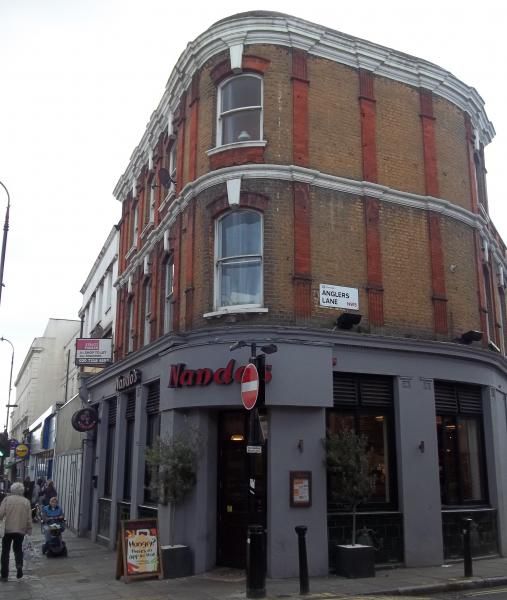
The pub closed in 1999 and reopened as a branch of Nandos in 2005. Some architectural features remain, including the green tiling on the ground floor replete with R&B roundels from its owners, Watney, Coombe & Reid.
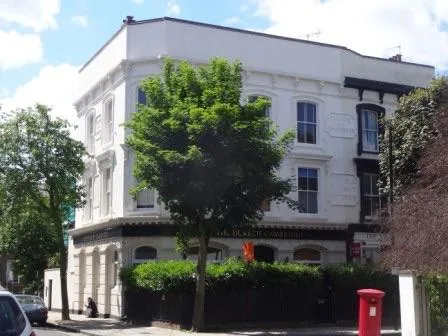
The Rolles family also ran the Duke of Cambridge on Lawford Road, which opened in 1868. During the mid-1930s it was regularly visited by George Orwell when he lived nearby and in 1987 it became the first pub in the area to appear in CAMRA’s Good Beer Guide. The following year the Doc Theatre company was established, staging their productions in a small L-shaped room on the first floor, ranging from Shakespeare to obscure examples such as ‘Yerma’ by Spanish playwright Federico Garcia Lorca. The theatre closed in 1998 when Camden Council granted permission for conversion into flats and the pub closed early the following year. The exterior is remarkably preserved with its original signage still visible.
Another well-preserved former pub is the Falkland Arms on Falkland Road, established in 1869. For many years an Ansell’s house, it was deeply involved in the local community, hosting meetings for the Falkland Darts Club, the Top Hat Club, the Dibbin Angling Society and the Falklands Social Club. This had some 60 members, regularly organising outings to the likes of Marlow, Street and Melbourne (Cambridgeshire). In 1996, planning permission was granted to convert the building into flats and it closed shortly after. The pub’s original exterior is relatively intact, with its signage and Ansell lanterns still visible.
The Mamelon Tower is a rare Victorian survivor on Grafton Road. Opened c.1850, it was originally known as the Manchester Tavern before it was renamed after a strategic hillock that featured in the siege of Sebastopol in the Crimean War. A Whitbread house in later years, the pub was described as a spacious building with snugs, slot machines, a pool table and an upright piano often in heavy usage.
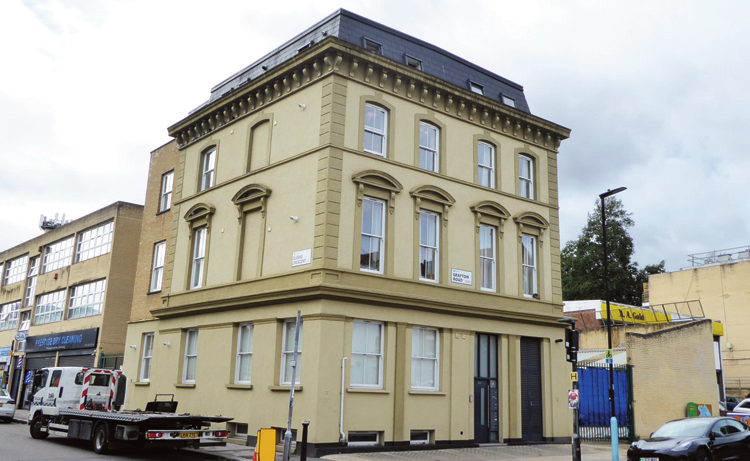
Live music from local bands was also a regular fixture. It was situated close to the weekly market on nearby Queen’s Crescent and the pub opened at 7.30 every Thursday and Saturday to serve the market traders. It closed in 2008 and, four years later, planning approval was given to convert the building into maisonettes.
The Dreghorn Castle, located near Queen’s Crescent Market, was established in c.1861 when the parade was constructed. Named after a 17th century mansion in Colinton (Edinburgh), it was built partly to resemble a medieval castle. One of its neighbours was the second ever branch of Sainsburys, which opened in 1872. For 65 years from 1900 it was ran by the Carrington family and was involved in a number of local charitable causes, including the annual fete for the Railways Servants Orphanage held at the Old Welsh Harp. Closed in 2001, it is currently a locally listed building with the upper floors occupied by flats and the ground floor space now a branch of Ladbrokes.
The Torriano Arms on Leighton Road was built in a similar period and named after local landowner Joshua Prole Torriano. A Truman’s house under the licence of George Streib who helped establish the Torriano Rifle Club, it was used by a number of groups, including the Foresters Lodge and the Torriano Mutal Loan Club. The pub had a lively and homely atmosphere and music gigs and comedy nights were a common fixture.
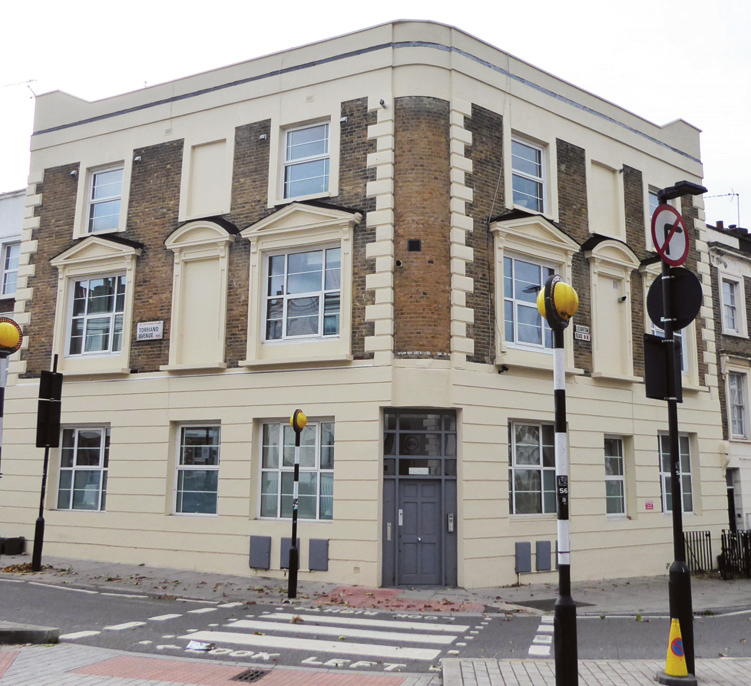
When it was threatened with redevelopment into flats in 1996, a young Pete Doherty (who lived in the area at the time) staged an impromptu benefit concert. The pub closed shortly after, while Doherty remains a vocal pub campaigner, throwing his support behind the nearby Bull & Gate when redevelopment plans were proposed.
A more recent loss is the George IV on Willes Road. Dating from c.1861, it was a replacement for a former 18th century pub that was once located opposite. An imposing two storey corner pub, it was noted for its distinct foliage covered frontage, replete with hanging baskets, rows of bay and sash windows bordered with stucco flange and pediments with George IV’s royal cypher proudly displayed on its central column.
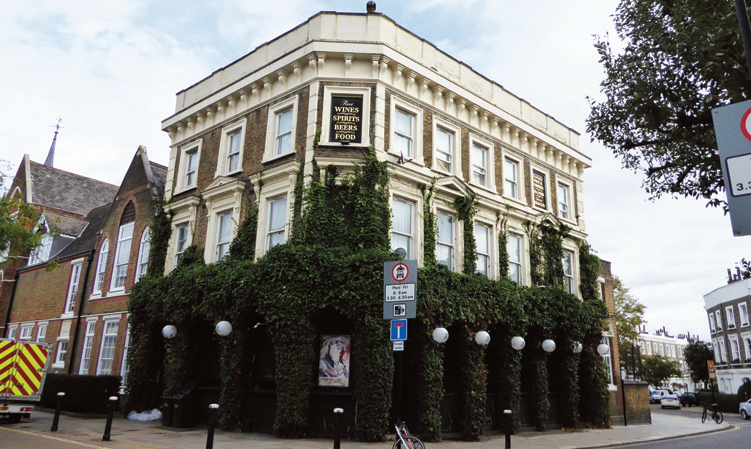
Over the years, it was a venue for local clubs including the Almin Old Age Pensioners Club and the local darts league. It was also often used for wedding receptions. The pub was described as a traditional back-street boozer with a cosy interior replete with old signs, a gabble of paintings and scores of red lamps. It sold a number of cask ales, while its menu included pies, platters and a range of eclectically named sandwiches including the Casino Special and Florida Melt. The pub closed during lockdown in 2020 and was sold the following year for £2.4 million. Unlike its contemporaries however, it could remain as a pub because it is on the market again via Estate Office Investments Ltd for in excess of £3 million.
Mike Goldwater