FULLER’S (PUBS) NEWS
In June, Fuller, Smith & Turner used the COVID Corporate Financing facility to raise £100 million of what is called ‘commercial paper’, a form of short-term funding. The company said that this would ensure that it had ‘a strong position with significant liquidity headroom’ to see it through until they were able to reopen their pubs. This was in addition to the company’s existing borrowing arrangements, which it hoped not to have to use. The company’s statement said, ‘Fuller’s is well financed with a healthy balance sheet and significant liquidity headroom. However, in light of continued uncertainty, pending further clarity from the Government as to when and how pubs will be allowed to reopen, management have taken additional precautionary measures to ensure the company is in the best possible financial position, with maximum flexibility.’ Fuller’s furloughed about 5,000 staff and senior executives and the board members agreed to a voluntary pay cut. Their share dividend was also cancelled.
Chief Executive Simon Emeny was one of many leading figures in the hospitality industry calling for the two metre ‘social distancing’ rule to be reduced to one metre. As a consequence of that happening, Fuller’s were able to open a limited number of pubs on 4 July, with the aim that at least 80% of Fuller’s 215 managed pubs and hotels would be open by the end of July.
Fuller’s have sold off the ‘Stable’ chain of pizza and cider bars, which they have wholly owned since June 2018. The price was not quoted. Under Fuller’s the chain grew from six outlets to 17, although there were only two in London, at Kew Bridge and in Whitechapel, with the latter then sold in June 2019. Most are located in the south west. The buyers are the Three Joes chain, which current operates three outlets, none of which are in London and there are no plans to open here. Simon Emeny said, “(The Stable) is a fantastic brand and we are proud to have helped it grow. The sale at this time will allow us to focus on the pubs and hotels that are at the core of our business and emerge from the current coronavirus crisis stronger.”
YOUNG’S NEWS
At the end of May and in expectation of reduced sales upon reopening, Young’s arranged additional finance of £70 million with several banks to cover the company for twelve months. Young’s then raised a further £88.4 million by issuing a number of both new ‘A’ and non-voting shares but, because of the method used, the offer was mostly taken up by institutional investors. The dividend for 2019/20 was cancelled and the larger share pool will reduce the dividend that is paid in future years to private shareholders.
Chief Executive Patrick Dardis, said that, with two metre ‘social distancing’ in place, “Some of our most famous pubs are simply not going to work.” He followed that comment with an article in the Daily Mail on 8 June in which he was particularly scathing about the rule and called on the Government to relax it as soon as possible for the sake of the whole hospitality industry.
Originally, Young’s set a reopening date of 3 August with a possibility of some pubs with large gardens or outside areas reopening earlier. This was based on ‘social distancing’ being reduced to one metre and when the change to one metre came earlier than was expected, possibly influenced by Mr Dardis’s comments, the date was brought forward to 20 July, although six pubs opened three days earlier. This was to test their service procedures and their ‘On Tap’ ‘app’, which the company is asking potential customers to download in advance (see their website). Some 5,000 staff were recalled from furlough.
The company’s financial year ended on 30 March. Pubs being closed for the final ten days had a disproportionate effect, costing the company some £13 million in lost revenue and wastage. Total group revenue for the year increased all the same, by 2.6% to £311.6 million. Mr Dardis commented, “I am proud of the performance of our business this year despite the unique challenges that we have faced. These results demonstrate the continued strength of our strategy of operating a differentiated, premium and well-invested pub estate.” He also thanked the Chancellor of the Exchequer for what he called ‘positive moves’ in the form of the Job Retention Scheme (furlough) and the business rates holiday. He added that despite monthly running costs of around £4 million, the company had paid all of its suppliers and commercial landlords, so as to ‘create goodwill and enhance our reputation and credibility all round’.
MITCHELLS & BUTLERS
M&B reported a loss of £121 million before tax for the six months ending 11 April. The company had seen a growth in like-for-like sales of 0.9% before ‘lockdown’. Chief executive Phil Urban commented to the Morning Advertiser, “The business was performing very well before the enforced closure in response to Covid-19, building on the strengths of our estate of mainly freehold properties, our diversified and well-loved brands and our team’s industry leading operational skills.” Consequently, the company has secured additional financial support totalling £250 million to cover it until 31 December 2021. M&B also borrowed £100 million through the Government’s Coronavirus Large Business Interruption Loan Scheme (CLBILS). Some 1,500 of the company’s 1,700 outlets were expected to have reopened by the end of July.
WETHERSPOON’S NEWS
Following the temporary reduction in VAT from 8 July (see page 11), JDW decided to pass on the reduction in the cost of food and non-alcoholic drinks to customers, including using a proportion of the savings to reduce the price of beers. The reductions vary according to JDW’s normal price banding policy. Chairman Tim Martin explained that this was a reaction to the tax advantages enjoyed by supermarkets, which he has campaigned against for many years. He did however acknowledge that, “Not every UK hospitality business will be able to reduce prices immediately. Some will need to retain the benefit of lower VAT just to stay in business. Others may need to invest in upgrading their premises. However, lower VAT and tax equality will eventually lead to lower prices, more employment, busier high streets and more taxes for the government.”
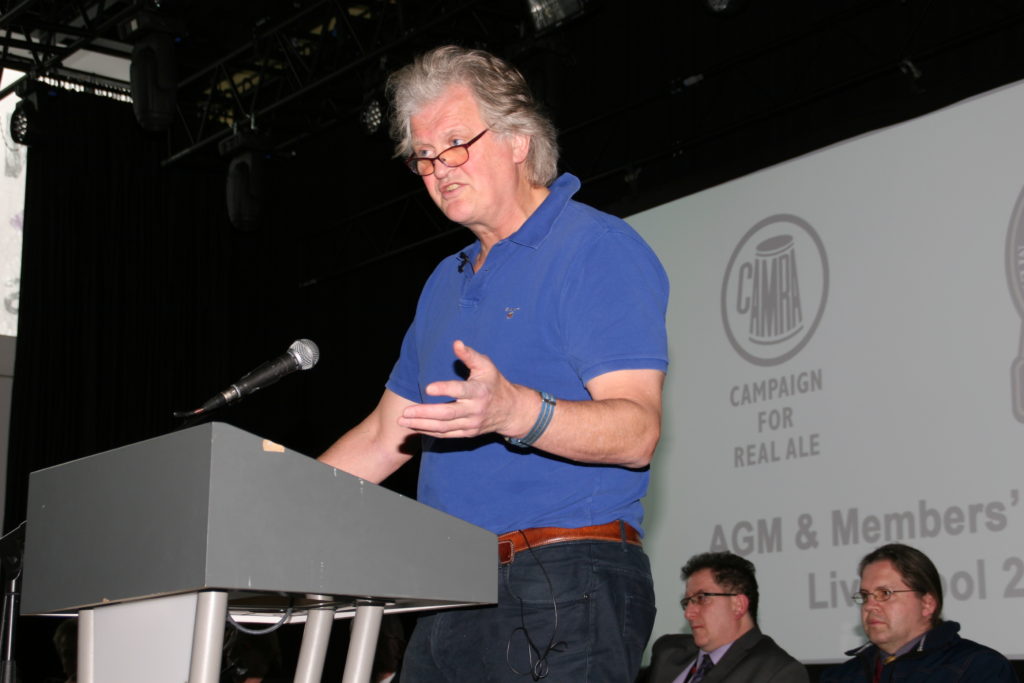
JDW’s posters advertising the price reductions carried the logos of both CAMRA and SIBA (the Society of Independent Brewers) which implied their approval. This was not so. A joint statement was issued by CAMRA’s Chief Executive, Tom Stainer, and James Calder, the Chief Executive of SIBA saying, “A recent promotional poster from pub chain JD Wetherspoon has made it necessary for us to clarify that the Chancellor’s temporary VAT reduction only applies to food served in pubs, and excludes alcoholic drink sales which many traditional local pubs rely on for survival. Like all pubs, Wetherspoon’s will not be able to benefit from a VAT reduction on beer sales and it is disappointing to see them potentially mislead customers into believing cheaper beer prices are as a direct result of the Chancellor’s measures. It is likely JDW can only offer these prices if it subsidises beer from increased profit on other revenue streams. Sadly, this is a strategy many independent, wet-led pubs do not have open to them. We’d hope consumers do not mistakenly believe CAMRA or SIBA have endorsed this marketing approach, which we believe is unhelpful for the pub industry as a whole and masks the truth that this VAT reduction will not directly result in cheaper beer prices and does little to help a large proportion of Britain’s pubs and brewers.”
In reply, JDW issued a long statement which refuted CAMRA and SIBA’s statement, explaining that they had ‘chosen to apply about one third of the tax reduction to meals and about two thirds of the tax reduction to draught beer’ and which ended, “The Chancellor’s tax cut will directly result in lower tax prices for every pub, since all pubs sell soft drinks and snacks, at least. It will be up to individual publicans to choose whether they use the tax cuts to reduce the price of a pint.”
In April, JDW made a share placing which raised around £141 million. The company also arranged a loan of £48.3 million with its existing bankers using the Coronavirus Large Business Interruption Loan Scheme (CLBILS). It was reported in the Mail on Sunday on 12 July that Tim Martin had sold shares in the company valued at just over £5 million. This reduces his shareholding to 27.4%. JDW shares were valued at over £16 before ‘lockdown’, fell to £5.59 in March but had risen to £9.84 by the time Mr Martin made his sale.
OLD KEGS FOR NEW
The Morning Advertiser (13 July) said that it had received reports from a number of publicans who suspected that Heineken had supplied them with kegs that had been returned to the brewery and relabelled with new ‘best before’ dates. The MA contacted Heineken and received the following reply. It is long but I think bears reporting in full, “Making sure pubs can be up and running safely with top quality beer is our top priority. The keg beer that exists in our network has been kept in optimum conditions and what’s more, has been benchmarked against reference samples to ensure it is still top quality. Ordinarily, 95% of kegs are returned to us within three weeks of filling, to be cleaned and filled again. Dates on kegs help licensees with stock rotation; it is a system that has worked for many years but given the current situation, it has allowed us to reassess. We know our beer and ciders in keg are as stable as can and bottle products, which have a best before date of up to a year. We have been very transparent about extending the ‘best before’ date on our kegs. We are replacing all unbroached kegs of Heineken product for free, with absolute certainty the beer is the highest quality. It is paramount for us, our customers and our consumers and we would never settle for second best when it comes to quality. Going forward, all our kegs will have the longer best before date on.”
The Society of Independent Brewers (SIBA) did not quite see it that way. Their Chief Executive, James Calder, responded, “During ‘lockdown’, independent breweries have had to dispose of thousands of gallons of beer and are only now beginning to deliver fresh beer into pubs. The idea that global brewers are simply shipping the same kegs of beer from before lockdown back into pubs will likely come as a huge shock to beer drinkers and publicans alike.”
BELGO
The owners of the Belgian beer and food bars, the Casual Dining Group went into administration on 2 July. 91 of the group’s 250 Café Rouge and Bella Italia outlets were closed immediately with the loss of 1,900 jobs. The group’s problems came largely from difficulty in paying the rent for its outlets. The administrators hope to sell most of the businesses as going concerns. No mention was made of the four Belgo outlets (Covent Garden, Holborn, Kings Cross and Nottingham) but they ought to attract a new owner easily enough.
GREENE KING ACKNOWLEDGE HISTORIC DEBT
Greene King have admitted that their founder, Benjamin Greene, owned sugar cane plantations in the West Indies which used slave labour. This occurred after he had founded the brewery. Like many slave owners, he received compensation when slavery was abolished which, according to the Guardian, was equivalent to £500,000 at today’s value. GK’s Chief Executive, Nick Mackenzie, was quoted in the Morning Advertiser as having told the Telegraph that, “While that is a part of our history, we are now focused on the present and future. Today, I am proud we employ 38,000 people across the UK from all backgrounds and that racism and discrimination have no place at Greene King. We don’t have all the answers, so that is why we are taking the time to listen and learn from all the voices, including our team members and charity partners as we strengthen our diversity and inclusion work. We plan to make a substantial investment to benefit the black, Asian and minority ethnic (BAME) community and support our race diversity in the business as we increase our focus on targeted work in this area.”
CORONA RETURNS
The production of Corona beer, along with other brands, started again on 1 June when the Mexican government lifted its ban on non-essential activities, which, by their definition, had included brewing beer.
Compiled by Tony Hedger